
洞察
需求模块中的洞察功能以直观、全面的可视化方式,汇总项目中规范或章节内需求的当前状态。此交互式工具可从整体上展示不同文件夹、规范和章节中需求的各个方面,例如需求状态、验证状态和讨论活动。借助此功能,您可以快速了解项目进度,并发现可能需要关注的领域。
访问洞察功能
要访问洞察功能,请进入项目中的需求模块,然后点击右上角的  按钮。
按钮。
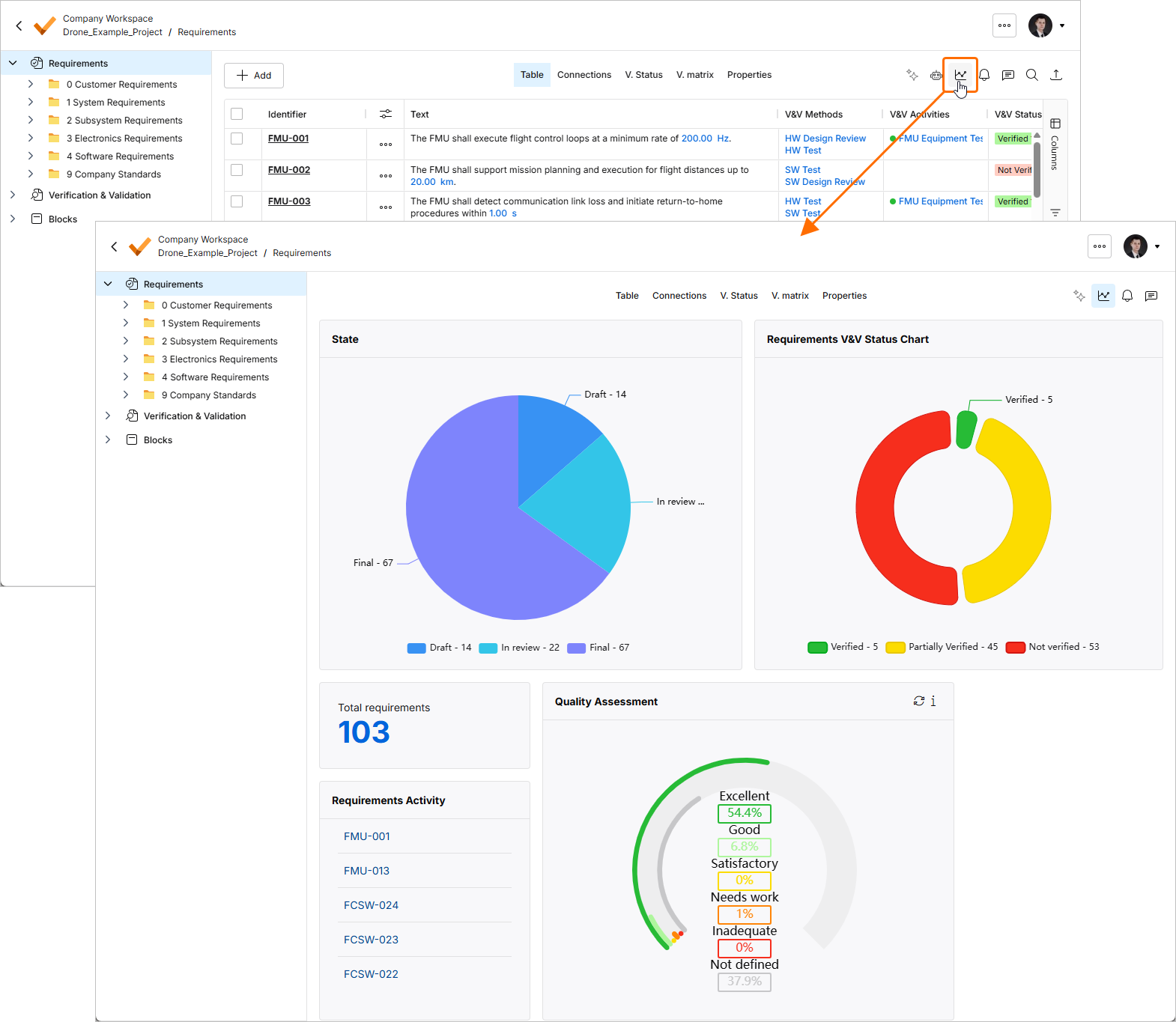
洞察界面
打开洞察功能后,您会看到多种图表。这些图表根据规范、章节或文件夹中的需求生成。目前,洞察功能显示以下信息。
-
状态
-
需求验证与确认(V&V)状态图
-
规范、章节或文件夹中的需求数量
-
需求活动(显示最近修改的需求)
-
质量评估图
状态图
此饼图显示处于不同状态的需求所占的比例:
-
Not Defined:尚未定义的需求。
-
Draft:目前处于草稿阶段的需求。
-
In Review:正在评审的需求。
-
Final:已定稿的需求。
需求验证与确认(V&V)状态图
另一个饼图显示规范中已验证、未验证或部分验证的需求数量。
-
Not Verified:尚未验证的需求。
-
Partial Verified:已部分验证的需求。
-
Verified:已完全验证的需求。
质量评估
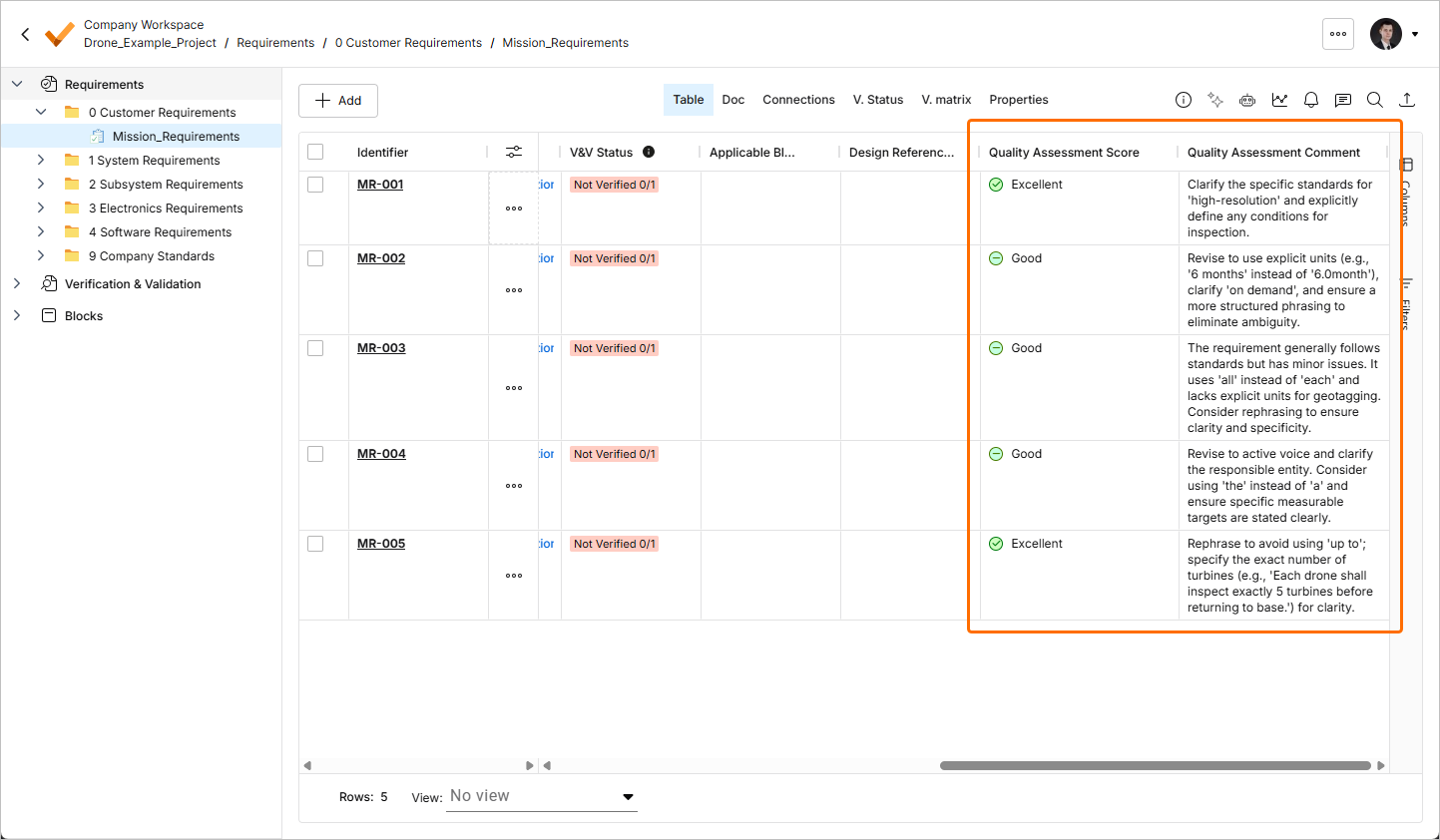
Quality Assessment 功能是一款由 AI 驱动的工具,旨在帮助您保持需求的高质量。此功能根据多项质量参数评估需求文本,为每条需求提供 Quality Assessment Score 和 Quality Assessment Comment,并显示在需求模块的相应列中。这样,您便可以快速识别可能需要进一步完善的需求。
访问质量评估功能
要使用质量评估功能,请选择需求,点击  按钮,然后选择 Assistant » Quality Assessment 命令。随后将打开 Quality Assessment 窗口,告知您将分析多少条需求。您可以使用 Prompt Extension 区域中的文本字段提供额外指示。
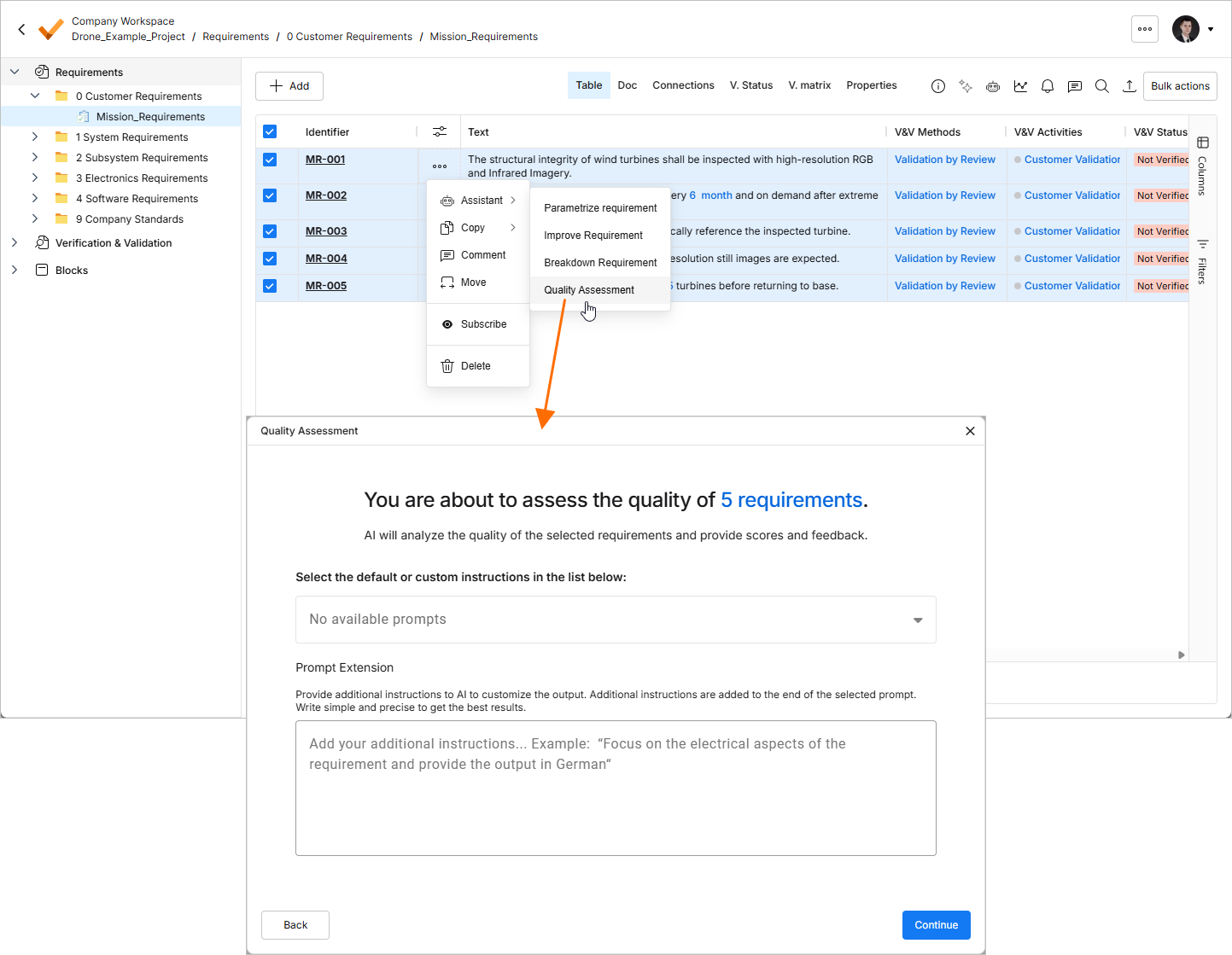
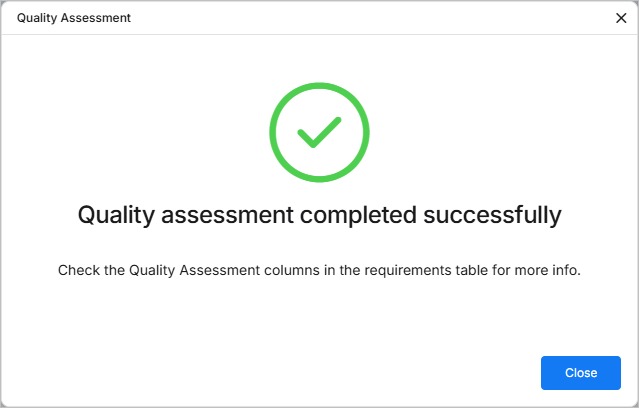
点击  继续。流程完成后,下一个窗口将提示您质量评估已成功完成。
规范表格中的 Quality Assessment Score 和 Quality Assessment Comment 列将提供有关需求文本质量的更多信息。
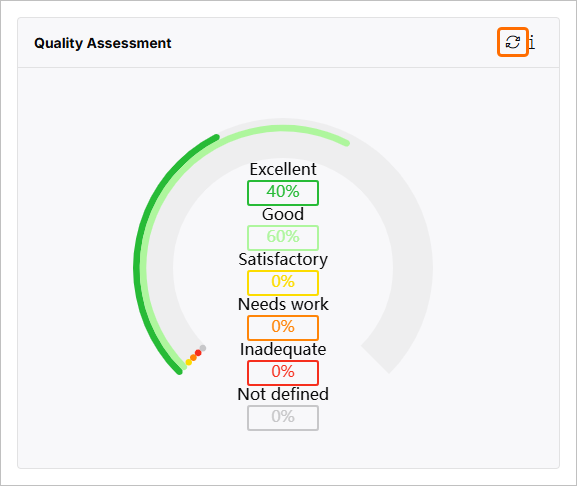
Insights 视图中的 Quality Assessment 图表将显示更新后的结果。 如果您希望重新评估,也可以点击图表右上角的  按钮进行刷新。
评分标准
-
Score: 0-20 / 1(第 1 级 - 不合格)
-
标准:需求文本违反多项 INCOSE 标准。缺乏结构,使用被动语态,包含含糊的术语,且语法和标点使用不当。未明确责任主体,或表述有歧义,或不具备可执行性。
-
-
Score: 21-40 / 2(第 2 级 - 需要改进)
-
标准:需求遵循部分标准,但存在明显问题。可能具备一定结构,但仍使用被动语态、包含免责条款,或缺乏具体、可衡量的目标。
-
-
Score: 41-60 / 3(第 3 级 - 合格)
-
标准:需求总体遵循标准,但存在一些小问题。可能基本具备完整结构,但包含轻微的语法错误,或缺少明确的计量单位。
-
-
Score: 61-80 / 4(第 4 级 - 良好)
-
标准:需求符合大多数标准。结构清晰,使用主动语态,目标具体且可衡量,但可能存在一两个小问题。
-
-
Score: 81-100 / 5(第 5 级 - 优秀)
-
标准:需求完全符合标准。结构清晰,使用主动语态,目标具体且可衡量,无语法错误,表述无歧义且具备可执行性。
-
评估时纳入考虑的 INCOSE 规则
R1 - Use a structured, complete sentence: subject, verb, object.
R2 - Use the active voice in the main sentence structure of the need or requirement statement with the responsible entity clearly identified as the subject of the sentence.
R3 - Ensure the subject and verb of the need or requirement statement are appropriate to the entity to which the need or requirement refers.
R5 - Use definite article “the” rather than the indefinite article “a”.
R6 - Use appropriate units when stating quantities. All numbers should have units of measure explicitly stated.
R7 - Avoid the use of vague terms such as “some”, “any”, “allowable”, “several”, “many”, “a lot of”, “a few”, “almost always”, “very nearly”, “nearly”, “about”, “close to”, “almost”, and “approximate”.
R8 - Avoid escape clauses such as “so far as is possible”, “as little as possible”, “where possible”, “as much as possible”, “if it should prove necessary”, “if necessary”, “to the extent necessary”, “as appropriate”, “as required”, “to the extent practical”, and “if practicable”.
R9- Avoid open-ended clauses such as “including but not limited to”, “etc.” and “and so on”.
R10 - Avoid superfluous infinitives such as “be designed to”, “be able to”, “be capable of”.
R12, 13, 14 - Use correct grammar, spelling, punctuation.
R15 - Use a defined convention to express logical expressions such as “[X AND Y]”, “[X OR Y]”, [X XOR Y]”, “NOT[X OR Y]”.
R16 - Avoid the use of “not”
R17 - Avoid the use of the oblique ("/") symbol except in units, i.e. km/hr
R18 - Write a single sentence that contains a single thought conditioned and qualified by relevant sub-clauses.
R19 - Avoid combinators that join clauses, such as “and”, “or”, ”then”, ”unless”, ”but”, ”as well as”, ”but also”, ”however”, ”whether”, ”meanwhile”, ”whereas”, ”on the other hand”, or ”otherwise”.
R20 - Avoid phrases that indicate the purpose of the need or requirement.
R21 - Avoid parentheses and brackets containing subordinate text.
R22 - Enumerate sets explicitly instead of using a group noun to name the set.
R24 - Avoid the use of pronouns and indefinite pronouns.
R26 - Avoid using unachievable absolutes such as 100'%' reliability, 100'%' availability, all, every, always, never, etc.
R28 - Express the propositional nature of a condition explicitly for a single action instead of giving lists of actions for a specific condition.
R29 - Classify the needs and requirements according to the aspects of the problem or system it addresses.
R31 - When defining design inputs avoid stating a solution unless there is rationale for constraining the design. Focus on the problem “what” rather than the solution “how”.
R32 - Use “each” instead of “all”, “any" or “both” when universal quantification is intended.
R33 - Define quantities with a range of values appropriate to the entity to which they apply and to which the entity will be verified or validated against.
R34 - Provide specific measurable performance targets appropriate to the entity to which the need or requirement is stated and against which the entity will be verified to meet.
R35 - Define temporal dependencies explicitly instead of using indefinite temporal keywords such as “eventually”, “until”, “before”, “after”, “as”, “once”, “earliest”, “latest”, “instantaneous”, “simultaneous”, “at last”.
R38 - Avoid the use of abbreviations.
质量评估图
此环形图显示需求的质量等级:
-
High:表示质量优秀的需求。
-
Medium:表示定义较为充分、但可能需要改进的需求。
-
Low:表示可能需要大幅完善的需求。
-
Not Defined:表示尚未评估或缺少足够信息的需求。
 AI 翻译
AI 翻译