
인사이트
요구사항 모듈의 인사이트 기능은 프로젝트의 사양/섹션 내 현재 요구사항 상태를 종합적으로 시각화하여 보여줍니다. 이 대화형 도구는 여러 폴더, 사양 및 섹션에 걸친 요구사항의 상태, 검증 상태, 토론 활동 등 다양한 측면을 한눈에 파악할 수 있도록 해줍니다. 이 기능을 통해 프로젝트의 진행 상황을 빠르게 파악하고 주의가 필요한 영역을 식별할 수 있습니다.
인사이트 접근하기
인사이트 기능에 접근하려면 프로젝트의 요구사항 모듈로 이동한 다음 오른쪽 상단의  버튼을 클릭합니다.
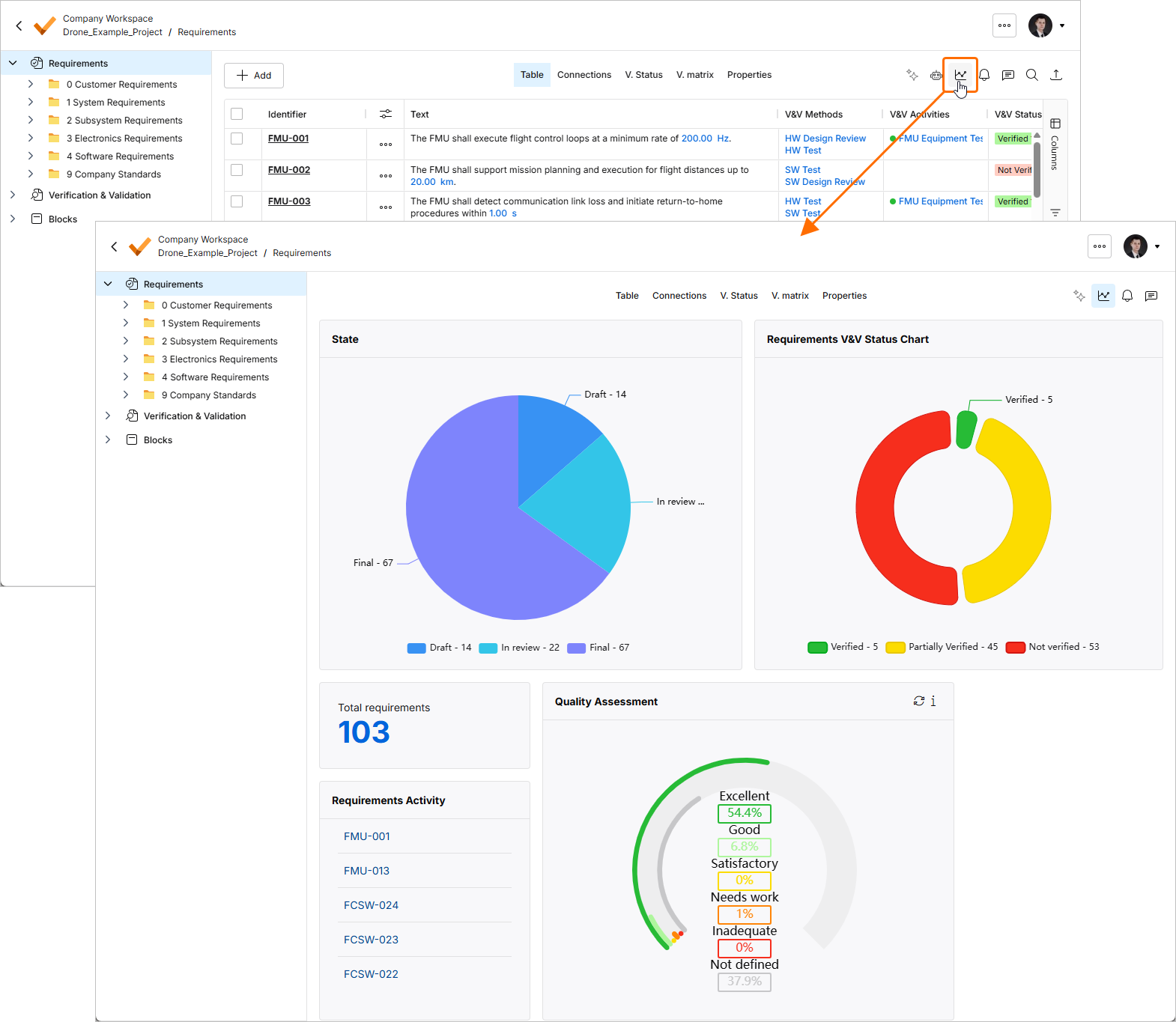
인사이트 인터페이스
인사이트 기능을 열면 여러 그래프가 표시됩니다. 이 그래프는 사양/섹션 또는 폴더 내 요구사항을 기반으로 생성됩니다. 현재 인사이트에는 다음 정보가 표시됩니다.
-
상태
-
요구사항 V&V 상태 차트
-
사양/섹션/폴더 내 요구사항 수
-
요구사항 활동(최근에 수정된 요구사항 표시)
-
품질 평가 그래프
상태 그래프
이 원형 차트는 각 상태에 해당하는 요구사항의 비율을 보여줍니다.
-
Not Defined: 아직 명세가 작성되지 않은 요구사항.
-
Draft: 현재 초안 단계에 있는 요구사항.
-
In Review: 검토 중인 요구사항.
-
Final: 최종 확정된 요구사항.
요구사항 V&V 상태 차트
또 다른 원형 차트는 사양 내에서 검증된 요구사항, 검증되지 않은 요구사항, 부분적으로 검증된 요구사항의 수를 보여줍니다.
-
Not Verified: 검증되지 않은 요구사항.
-
Partial Verified: 부분적으로 검증된 요구사항.
-
Verified: 완전히 검증된 요구사항.
품질 평가
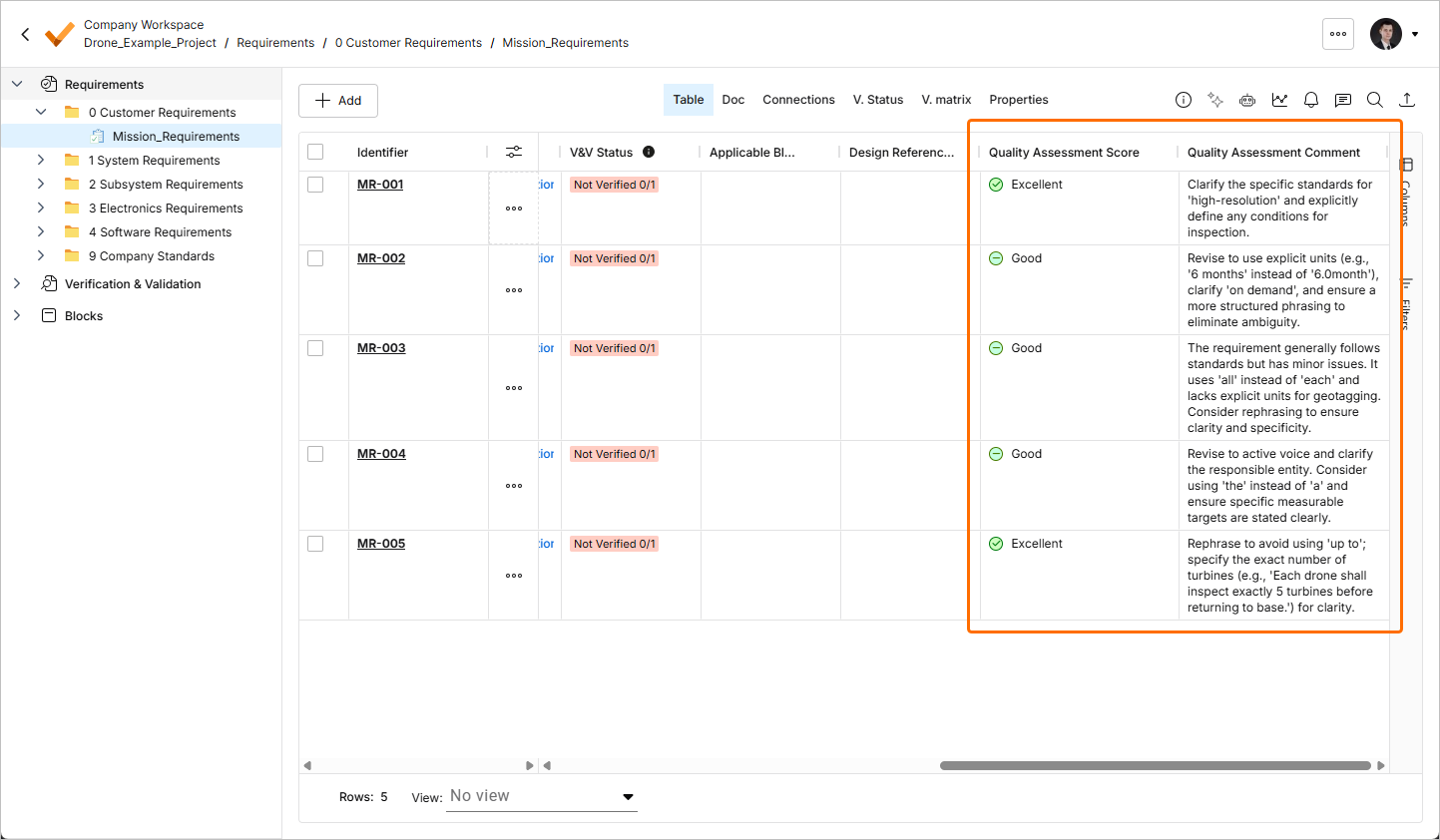
Quality Assessment 기능은 요구사항의 품질을 높게 유지하도록 돕는 AI 기반 도구입니다. 이 기능은 여러 품질 기준에 따라 텍스트를 평가하여 각 요구사항에 대한 Quality Assessment Score 및 Quality Assessment Comment을 제공하며, 이는 요구사항 모듈의 해당 열에 표시됩니다. 이를 통해 추가 개선이 필요한 요구사항을 빠르게 식별할 수 있습니다.
품질 평가 접근하기
품질 평가 기능을 사용하려면 요구사항을 선택하고  버튼을 클릭한 다음 Assistant » Quality Assessment 명령을 선택합니다. Quality Assessment 창이 열리고 분석할 요구사항 수가 안내됩니다. Prompt Extension 영역의 텍스트 필드에서 추가 지침을 입력할 수 있습니다.
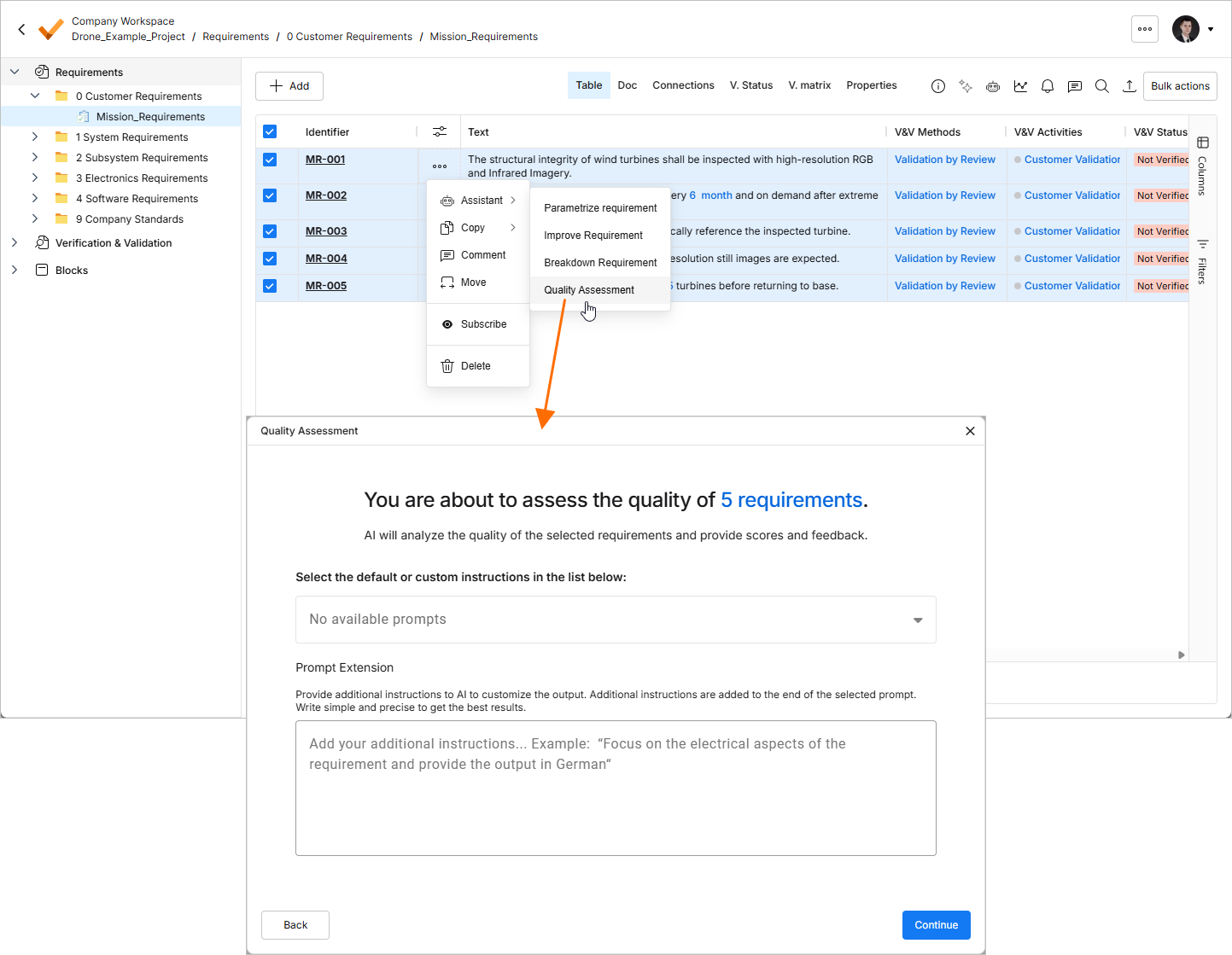
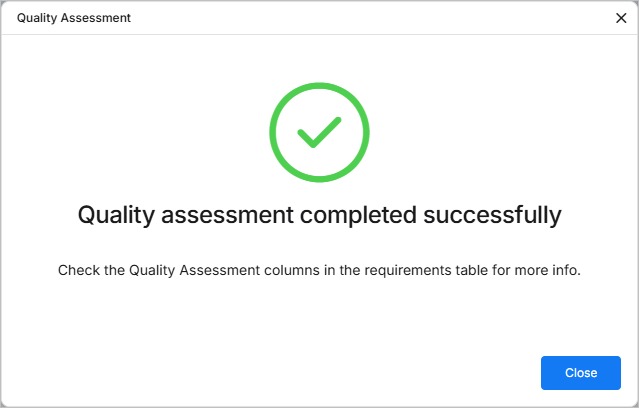
계속하려면  을 클릭합니다. 프로세스가 완료되면 다음 창에 품질 평가가 성공적으로 완료되었다는 안내가 표시됩니다.
사양 표의 Quality Assessment Score 및 Quality Assessment Comment 열에서 요구사항 텍스트의 품질에 대한 추가 정보를 확인할 수 있습니다.
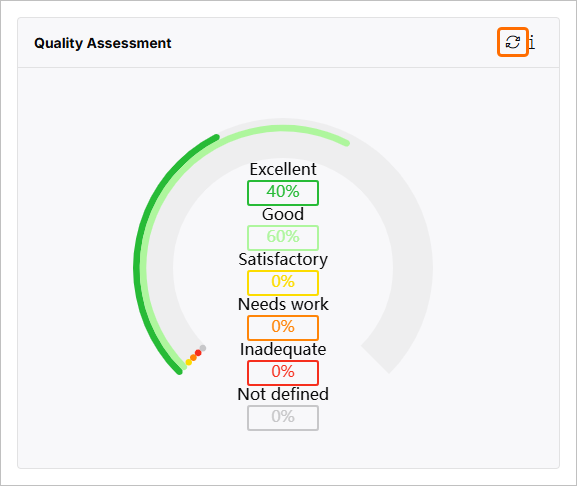
Insights 보기의 Quality Assessment 그래프에 업데이트된 결과가 표시됩니다. 새로 평가하려면 그래프 오른쪽 상단의  버튼을 클릭하여 새로 고칠 수도 있습니다.
점수 평가 기준
-
Score: 0-20 / 1 (레벨 1 - 부적절)
-
기준: 요구사항 텍스트가 여러 INCOSE 표준을 위반합니다. 구조가 미흡하고 수동태와 모호한 용어를 사용하며 문법 및 문장 부호가 부정확합니다. 책임 주체가 명확하지 않거나, 내용이 모호하거나, 실행할 수 없습니다.
-
-
Score: 21-40 / 2 (레벨 2 - 개선 필요)
-
기준: 요구사항이 일부 표준을 따르지만 중대한 문제가 있습니다. 어느 정도 구조화되어 있을 수 있으나 여전히 수동태를 사용하거나, 회피 조항을 포함하거나, 구체적이고 측정 가능한 목표가 부족합니다.
-
-
Score: 41-60 / 3 (레벨 3 - 양호)
-
기준: 요구사항이 전반적으로 표준을 따르지만 사소한 문제가 일부 있습니다. 대체로 구조화되어 있으나 사소한 문법 오류가 있거나 구체적인 측정 단위가 누락되어 있을 수 있습니다.
-
-
Score: 61-80 / 4 (레벨 4 - 우수)
-
기준: 요구사항이 대부분의 표준을 준수합니다. 구조가 잘 잡혀 있고 능동태를 사용하며 구체적이고 측정 가능한 목표가 있으나, 한두 가지 사소한 문제가 있을 수 있습니다.
-
-
Score: 81-100 / 5 (레벨 5 - 탁월)
-
기준: 요구사항이 표준을 완전히 준수합니다. 구조가 명확하고 능동태를 사용하며 구체적이고 측정 가능한 목표가 있습니다. 문법 오류가 없고 명확하며 실행 가능합니다.
-
평가에 고려된 INCOSE 규칙
R1 - Use a structured, complete sentence: subject, verb, object.
R2 - Use the active voice in the main sentence structure of the need or requirement statement with the responsible entity clearly identified as the subject of the sentence.
R3 - Ensure the subject and verb of the need or requirement statement are appropriate to the entity to which the need or requirement refers.
R5 - Use definite article “the” rather than the indefinite article “a”.
R6 - Use appropriate units when stating quantities. All numbers should have units of measure explicitly stated.
R7 - Avoid the use of vague terms such as “some”, “any”, “allowable”, “several”, “many”, “a lot of”, “a few”, “almost always”, “very nearly”, “nearly”, “about”, “close to”, “almost”, and “approximate”.
R8 - Avoid escape clauses such as “so far as is possible”, “as little as possible”, “where possible”, “as much as possible”, “if it should prove necessary”, “if necessary”, “to the extent necessary”, “as appropriate”, “as required”, “to the extent practical”, and “if practicable”.
R9- Avoid open-ended clauses such as “including but not limited to”, “etc.” and “and so on”.
R10 - Avoid superfluous infinitives such as “be designed to”, “be able to”, “be capable of”.
R12, 13, 14 - Use correct grammar, spelling, punctuation.
R15 - Use a defined convention to express logical expressions such as “[X AND Y]”, “[X OR Y]”, [X XOR Y]”, “NOT[X OR Y]”.
R16 - Avoid the use of “not”
R17 - Avoid the use of the oblique ("/") symbol except in units, i.e. km/hr
R18 - Write a single sentence that contains a single thought conditioned and qualified by relevant sub-clauses.
R19 - Avoid combinators that join clauses, such as “and”, “or”, ”then”, ”unless”, ”but”, ”as well as”, ”but also”, ”however”, ”whether”, ”meanwhile”, ”whereas”, ”on the other hand”, or ”otherwise”.
R20 - Avoid phrases that indicate the purpose of the need or requirement.
R21 - Avoid parentheses and brackets containing subordinate text.
R22 - Enumerate sets explicitly instead of using a group noun to name the set.
R24 - Avoid the use of pronouns and indefinite pronouns.
R26 - Avoid using unachievable absolutes such as 100'%' reliability, 100'%' availability, all, every, always, never, etc.
R28 - Express the propositional nature of a condition explicitly for a single action instead of giving lists of actions for a specific condition.
R29 - Classify the needs and requirements according to the aspects of the problem or system it addresses.
R31 - When defining design inputs avoid stating a solution unless there is rationale for constraining the design. Focus on the problem “what” rather than the solution “how”.
R32 - Use “each” instead of “all”, “any" or “both” when universal quantification is intended.
R33 - Define quantities with a range of values appropriate to the entity to which they apply and to which the entity will be verified or validated against.
R34 - Provide specific measurable performance targets appropriate to the entity to which the need or requirement is stated and against which the entity will be verified to meet.
R35 - Define temporal dependencies explicitly instead of using indefinite temporal keywords such as “eventually”, “until”, “before”, “after”, “as”, “once”, “earliest”, “latest”, “instantaneous”, “simultaneous”, “at last”.
R38 - Avoid the use of abbreviations.
품질 평가 그래프
이 원형 그래프는 요구사항의 품질 수준을 보여줍니다.
-
High: 품질이 뛰어난 요구사항을 나타냅니다.
-
Medium: 적절히 정의되어 있지만 개선이 필요할 수 있는 요구사항을 나타냅니다.
-
Low: 상당한 개선이 필요할 가능성이 높은 요구사항을 나타냅니다.
-
Not Defined: 평가되지 않았거나 충분한 정보가 없는 요구사항을 나타냅니다.
 AI로 번역됨