
Installing & Managing Altium Designer Agile
Installation of Altium Designer Agile is both intuitive and fast, courtesy of the Altium Designer Agile Installer. This wizard-based installer streamlines the initial installation process.
This page takes a look at the procedure for installing Altium Designer Agile on a computer.
Obtaining the Installer
To access the Altium Designer Agile Installer, you need first to download and run an executable – AltiumDesignerAgileSetup.exe. This executable is downloaded from the Home page of the browser interface of your Altium Agile Workspace (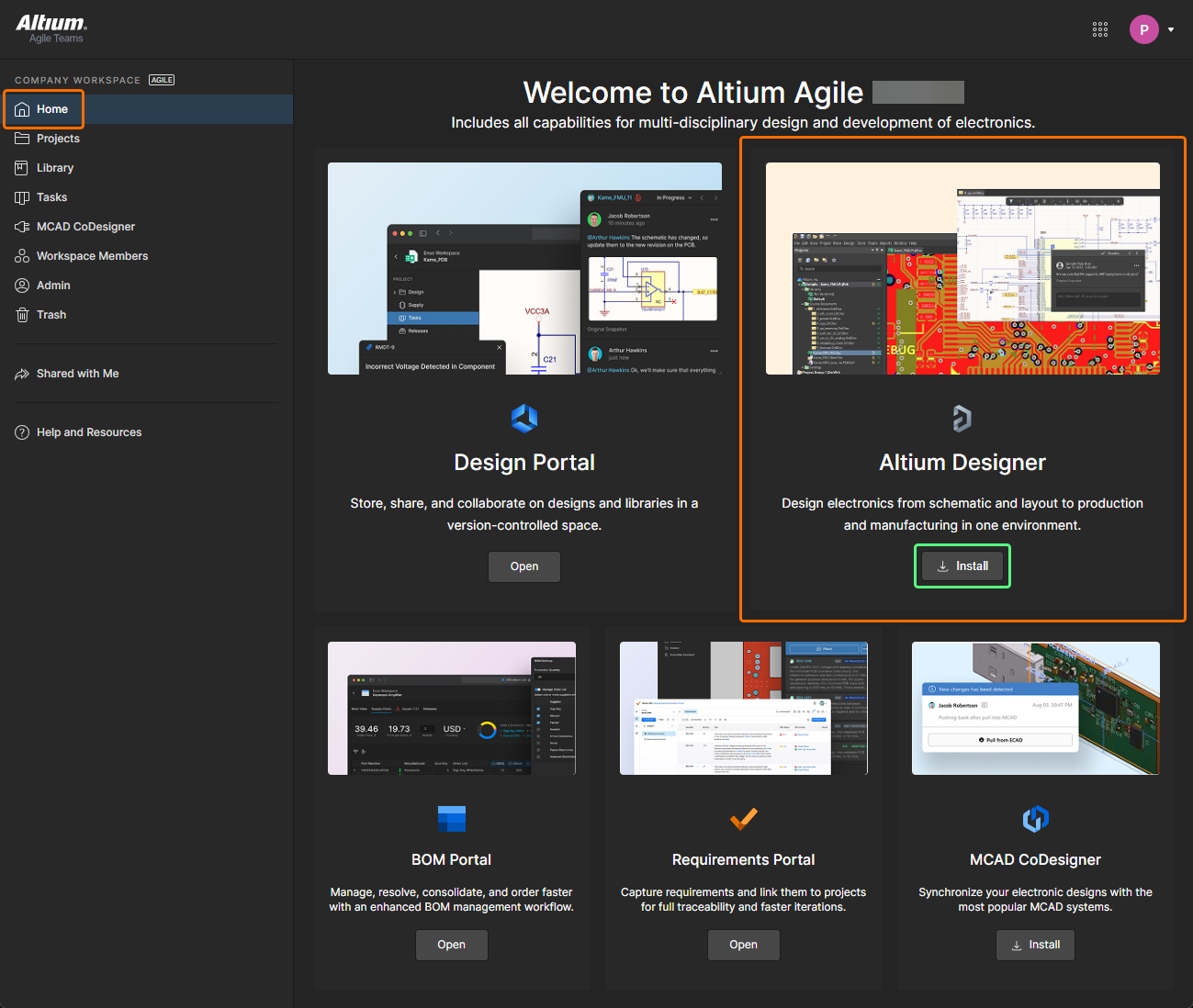 ) and can be saved anywhere on your hard disk.
Running the Installer
Double-click the AltiumDesignerAgileSetup.exe file. The installer itself is wizard-based, providing a set of progressive (and intuitive) pages that collectively gather the information to effectively install the version of the software and its initial feature set as you require. The following sections provide a summary of the various pages you will encounter.
Master Services Agreement
This page of the Installer presents you with the Master Services Agreement (MSA).
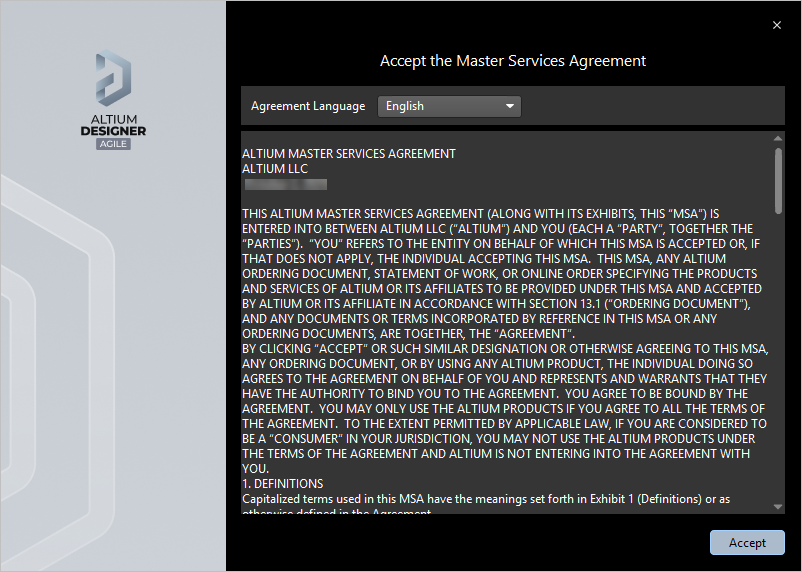 Read and accept the Master Services Agreement.
Before you can continue with the installation of the software, you must read through and accept the terms of the MSA. It can be viewed in different languages, including English (the default), German, French, Japanese, Italian, and Korean.
After reading the MSA, continue with the installation by clicking the  button.
Signing In
Use the next page of the Installer to sign in to your Altium Account to which your valid license is associated. The reason for this is two-fold:
-
First, it verifies your identity and that the installation of the software is valid as determined by your Altium Account and licensing.
-
Second, it provides secure access to the Altium Cloud Repository in which the installation files reside – the files that are required to be downloaded before the software can be ultimately installed on the PC.
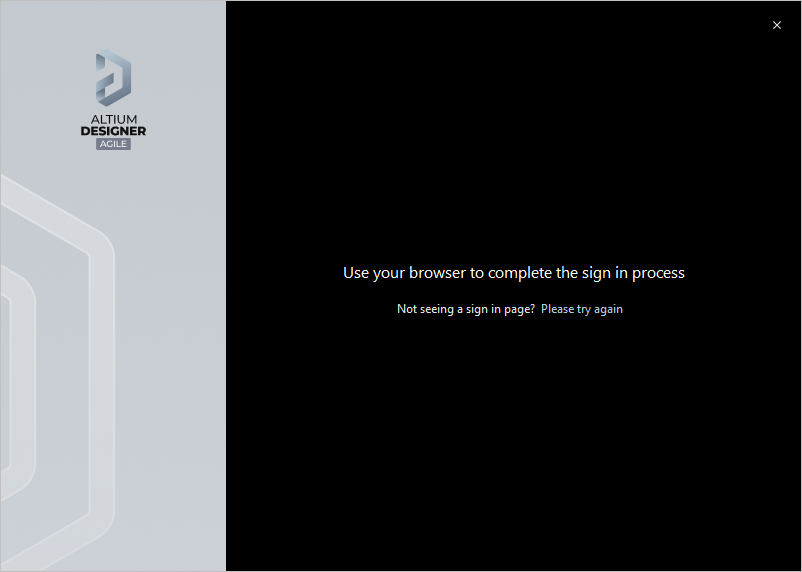
Signing in is performed using your browser. Your default browser will open with a page from which you can sign in to your Altium Account using your preferred (and accessible) method. Once signed in, the next page of the Installer will automatically open.
Installation Mode and Destination Folders
This next page of the Installer allows you to specify the destination folders for the installation in terms of both the Program Files for the software and the Shared Documents that are accessed and used by the software.
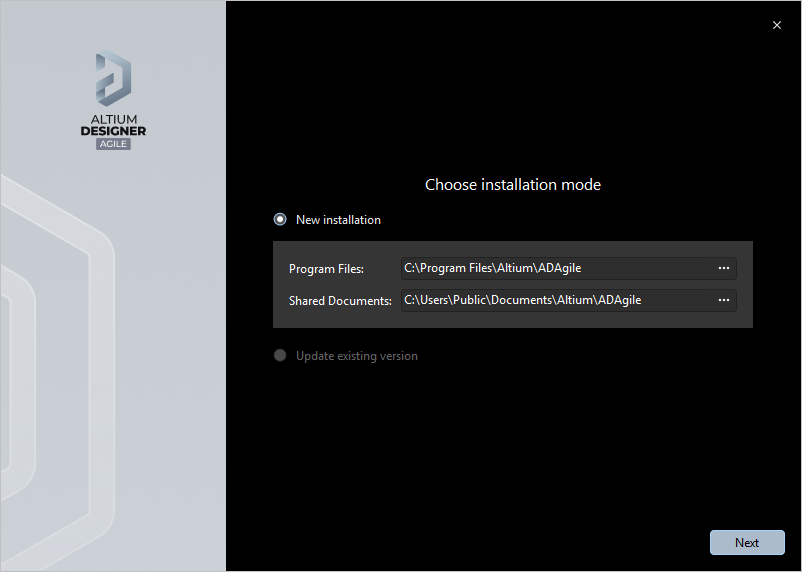
Specify where the software and associated documents are to be installed.
These locations become especially important when installing multiple instances of Altium Designer Agile. If one or both of these destinations is not currently an empty folder (i.e., devoid of content), you will be prevented from proceeding with the installation until you specify alternate (and empty) destination(s).
The default destinations are:
-
Program Files:
C:\Program Files\Altium\ADAgile -
Shared Documents:
C:\Users\Public\Documents\Altium\ADAgile
To specify alternate locations, type the location directly into the applicable field or click the folder icon at the right of a field and browse for the required destination folder.
Once the install locations are specified, click  to proceed.
Selecting Design Functionality
This next page of the Installer allows you to specify which features are installed initially. The PCB Design option provides the base software and core technologies required to perform PCB design. It is always installed and cannot be deselected. Use the remaining options to tailor the installation to suit your needs.

What initial functionality would you like in your installation of Altium Designer Agile? The choice is yours! This can be changed later if required.
Click to enable the functionality you require. Click to enable functionality at the parent level to quickly enable all of its child functionality too.
After defining the functionality you would like, click  to go ahead and proceed with the installation.
Installing Altium Designer Agile
The installation will proceed with the required files first being downloaded from the Altium Cloud Repository. Progress of this download is displayed within the Installer itself. Once the download of files is complete, they will be installed, again with progress displayed in the Installer.
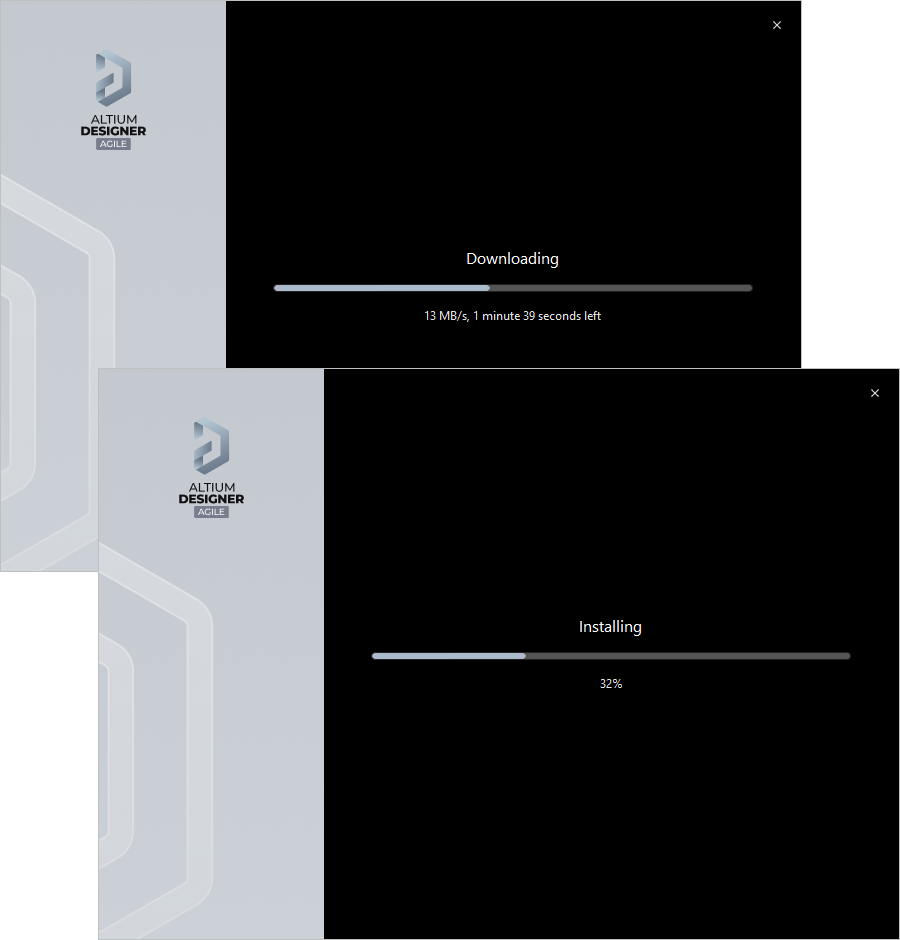
Installation commences by downloading the required set of install files. After the download is complete, the software is then installed.
Installation Complete
When the installation itself is complete, you have reached the end of the Installer wizard.
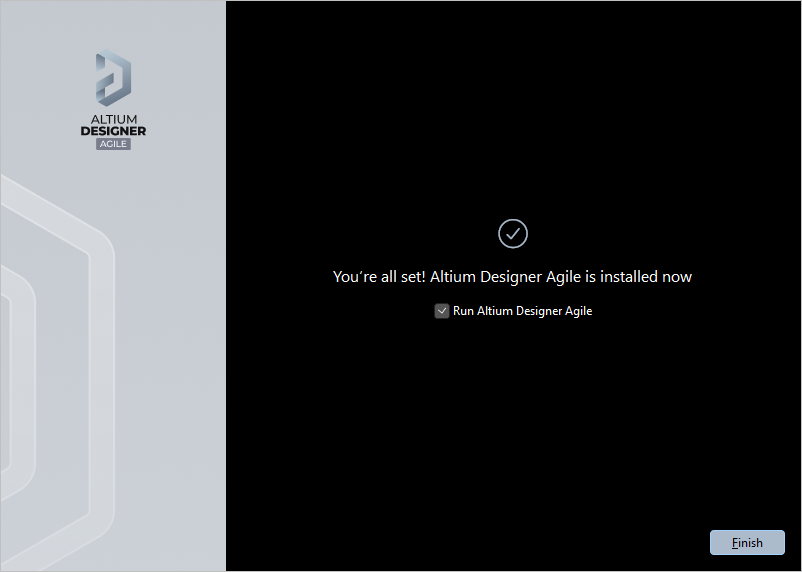
Installation is complete!
The Run Altium Designer Agile option is provided to launch Altium Designer Agile when you exit the Installer, which is enabled by default. Click  to exit the wizard.
You have installed Altium Designer Agile on your computer. Now it is time to do what you do best and go create that next innovative (and hopefully lucrative) product!
Installing Multiple Instances of the Software
When running the installer for a subsequent version of Altium Designer Agile, you will be provided with the choice of either updating an existing version instance of Altium Designer Agile or installing it as a separate new version instance. When selecting the installation mode, choose the New installation option to maintain separate version instances of the software on the same computer. Remember to specify different destination folders for the new instance later in the wizard.
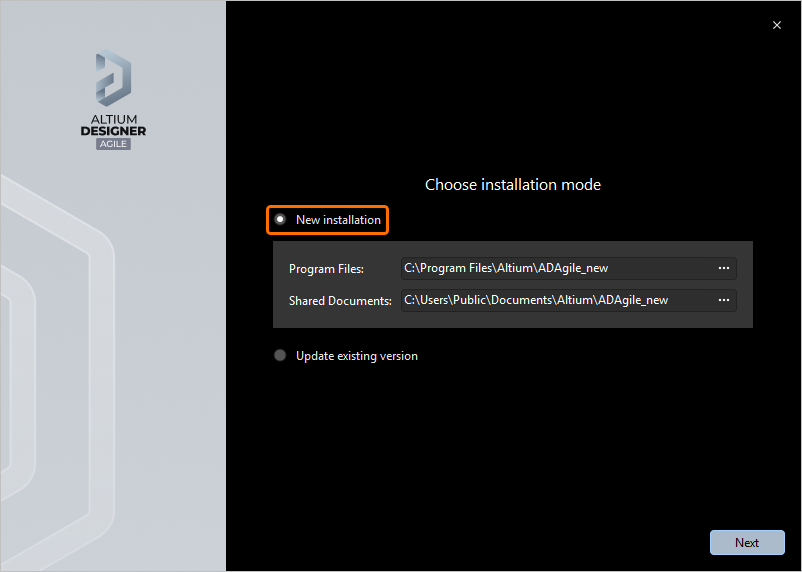
If you already have a previous installation of Altium Designer Agile, you can choose to install it as a separate unique instance by selecting the New installation option as the mode of installation.
Installation Folders
There are two important factors that facilitate the installation of multiple individual version instances of the software:
-
The ability to specify different destination folders during the install in terms of both the Program Files and Shared Documents install locations.
-
The system's use of a Globally Unique Identifier (GUID) for each independent instance. This identifier, which uses the standard 128-bit URN model and is displayed as a 32-character hexadecimal number, is used to uniquely distinguish the application data folders, as well as entries in the registry. When you run a particular instance of Altium Designer Agile, the system handles (through use of this identifier) only those files and registry entries specific to that instance.
The following is a summary of the default installation folders for Altium Designer Agile:
-
The default main installation path for Altium Designer Agile is:
\Program Files\Altium\ADAgile -
Examples and templates for a default installation can be found in the following directory:
\Users\Public\Documents\Altium\ADAgile -
System application data (including Extensions, Portal Cache) and security files (license ALF) for a particular instance can be found in the following two directories:
\ProgramData\Altium\Altium Designer Agile
\ProgramData\Altium\Altium Designer Agile_SecurityFor two example instances, the paths might, therefore, be (inserting example GUIDs):
\ProgramData\Altium\Altium Designer Agile {7DF7280E-CD03-40A9-A6A4-DDD057140F70}
\ProgramData\Altium\Altium Designer Agile {7DF7280E-CD03-40A9-A6A4-DDD057140F70}_Security
\ProgramData\Altium\Altium Designer Agile {566C1AFA-49CA-4B17-B7CB-70A2042D8DAC}
\ProgramData\Altium\Altium Designer Agile {566C1AFA-49CA-4B17-B7CB-70A2042D8DAC}_Security -
User application data files (including:
DXP.rcs,UserTools.tlt,AdvPCB.dft,AdvSch.dft, last design space) for a particular instance can be found in the following directory:\Users\<ProfileName>\AppData\Roaming\Altium\Altium Designer Agile <GUID>For two example instances, and a user profile of
Des.Igner, the paths would, therefore be:\Users\Des.Igner\AppData\Roaming\Altium\Altium Designer Agile {7DF7280E-CD03-40A9-A6A4-DDD057140F70}
\Users\Des.Igner\AppData\Roaming\Altium\Altium Designer Agile {566C1AFA-49CA-4B17-B7CB-70A2042D8DAC} -
User local application data for a particular instance can be found in the following directory:
\Users\<ProfileName>\AppData\Local\Altium\Altium Designer Agile <GUID>For two example instances, and a user profile of
Des.Igner, the paths would, therefore be:\Users\Des.Igner\AppData\Local\Altium\Altium Designer Agile {7DF7280E-CD03-40A9-A6A4-DDD057140F70}
\Users\Des.Igner\AppData\Local\Altium\Altium Designer Agile {566C1AFA-49CA-4B17-B7CB-70A2042D8DAC}
Identifying the Right Folder
For the main program installation and shared documents folders, you have the ability to give those folders meaningful names, which can come in very handy for a machine containing multiple different version instances of the software. But for other folders, they are only distinguished by their GUID. Being able to tell that you have the right folder for the right version instance suddenly becomes more difficult. However, help is at hand. By using the Preferences dialog, you can quickly identify the GUID used for the currently open instance of the software. Armed with that knowledge, you can pick the right folder through Windows Explorer.
The GUID can be identified on the following pages of the Preferences dialog (in a standard default installation of Altium Designer Agile):
-
Data Management – Backup: in the Path field.
-
PCB Editor – Models: in the Directory field for Temporary Mesh Data.
-
CAM Editor – General: in the Default log files location field.

Identifying the GUID used for the active version instance of Altium Designer Agile.
Importing Preferences from a Previous Version
After installing and launching your new version of Altium Designer Agile, the Import settings dialog will open. In this dialog, you can choose to import preferences from the most recent previous installation at startup.
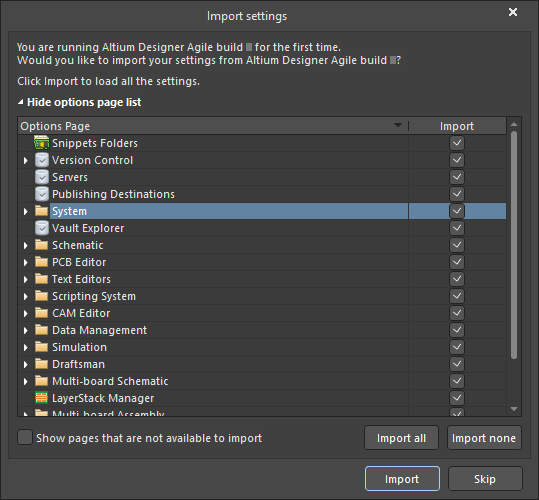
Import settings from your previous version's installation.
Not only will the preferences be imported, but the user settings will also be copied across – ensuring the new version opens with the same look and feel created in the previous version, even down to the last opened project group and panel positioning!
If the option to import preferences upon initial startup is not taken, do not worry – preferences can be quickly imported at any time from within the Preferences dialog. Refer to the Accessing, Defining & Managing System Preferences page to learn more.
Altium Product Improvement Program
Altium uses the Altium Product Improvement Program to enhance our understanding of how our customers use Altium products and services. The data is transmitted via a secure connection so your privacy is protected. You do not need to send us anything; your computer will automatically send usage information to Altium servers, and participation will not impact software performance or cause any work interruptions. The data we collect cannot be used to recreate your work, products or designs.
By default, participation in the program is enabled. You can configure this after installation. The option to participate or not is available from the System – Product Improvement page of the Preferences dialog (accessed by clicking the  button at the top right of the design space). Alternatively, you can enable/disable participation using the Product Improvement option on the System – Network Activity page of the Preferences dialog.
Browsing Installed Functionality
Information about your current installation can be readily seen from the Installed page of the Extensions and Updates view. To access the page, click on the Current User control at the top right of the design space, choose  from the menu, and then click Installed at the top of the view.
The page presents the following information:
-
The version of the main Altium Designer Agile platform currently installed, along with the user (and computer name) and Company Account under which a valid license of the software is being used. License/subscription notification information is also presented here. When the license/subscription status requires attention, its overview text is highlighted in red – this can be due to an invalid license, an expired (or soon expiring) subscription, or a portal connection issue.
-
The system extensions currently installed.
-
The software extensions currently installed.
To learn more about extensions, refer to the Extending Your Installation page.
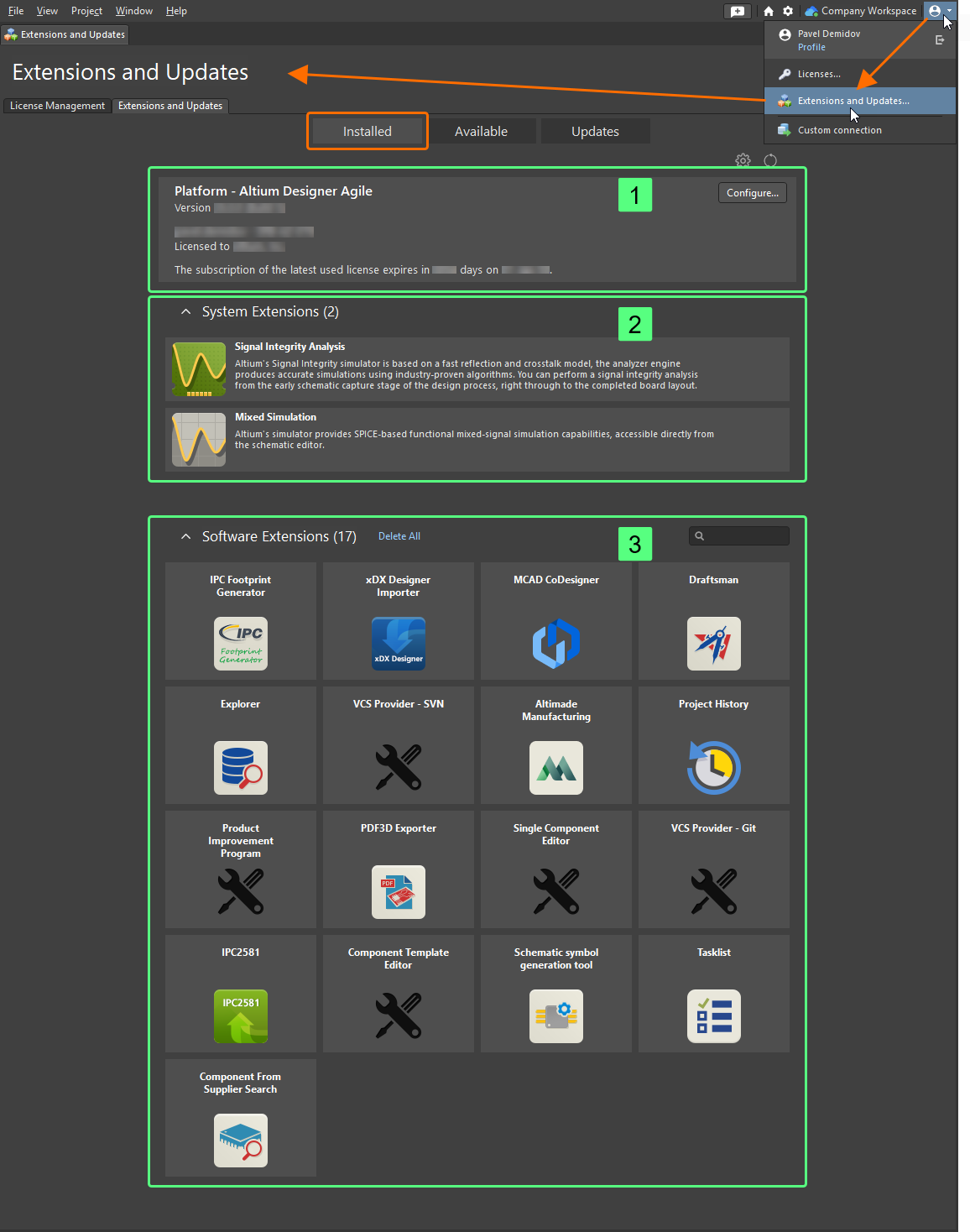
Access the Installed page of the Extensions and Updates page for a summary of what is currently installed in your instance of Altium Designer Agile.
Changing Installed Core Functionality after Installation
During initial installation of Altium Designer Agile, you have a choice over the core design functionality you want to be installed (refer to the Selecting Design Functionality section to learn more). This choice is not 'set in stone', however, and can be modified at any time after installation. This can be performed in two places:
-
Internally from within Altium Designer Agile from the Installed page of the Extensions and Updates view.
-
Externally from within Windows from the standard Programs and Features page (accessed from the Control Panel).
Changing Core Functionality from Altium Designer Agile
-
Access the Extensions and Updates view (click on the Current User control at the top right of the design space then choose
 from the menu) and switch to the Installed tab.
-
Click the
 button at the top right of the Platform region. This accesses the Configure Platform page, which presents Altium Designer Agile's core feature set, including platform extensions. The page is identical in content to that found on the page of the Altium Designer Agile Installer on which you select the design functionality.

Configure the core functionality for your installation directly from within Altium Designer Agile. -
Make changes to the installed core feature set as required by checking/unchecking the box next to a feature. Modifications are distinguished by the applicable entry becoming bold. Quickly enable all features in a particular section for installation using the corresponding All On control at the top right of that section.
-
Once modifications have been made, click the
 button at the top right of the page. A confirmation dialog will open. Click OK to apply the changes and restart Altium Designer Agile. The instance of Altium Designer Agile will close, and a window will appear showing progress in downloading and installing the files required to implement the change(s).
-
Altium Designer Agile will then be restarted.
Changing Core Functionality from Windows
-
Access the Programs and Features page through the Windows Control Panel then right-click on the entry for Altium Designer Agile <Version> and use the Change command from the context menu.

Modify the installation at any stage by changing the core functionality installed. -
The Altium Designer Agile Installer wizard will be presented. Log in to your Altium Account, and you will be taken to the design functionality selection page (refer to the Selecting Design Functionality section to learn more about the page). Make changes to the installed core feature set as required then click
 .
.
-
The files required to implement the change will be downloaded and installed. Once the modification to the installation is complete, an option is provided to launch Altium Designer Agile when you exit the Installer, which is enabled by default. Click
 to exit the wizard.
Updating to a Later Version
Altium Designer Agile can be updated from two places:
-
Internally from within Altium Designer Agile: from the Updates page of the Extensions and Updates view.
-
Externally from within Windows: by running the Installer of a later version.
Updating from Altium Designer Agile
Access the Updates page of the Extensions and Updates view to browse a listing of all software elements of Altium Designer Agile, for which there is an update, including Platform Updates.
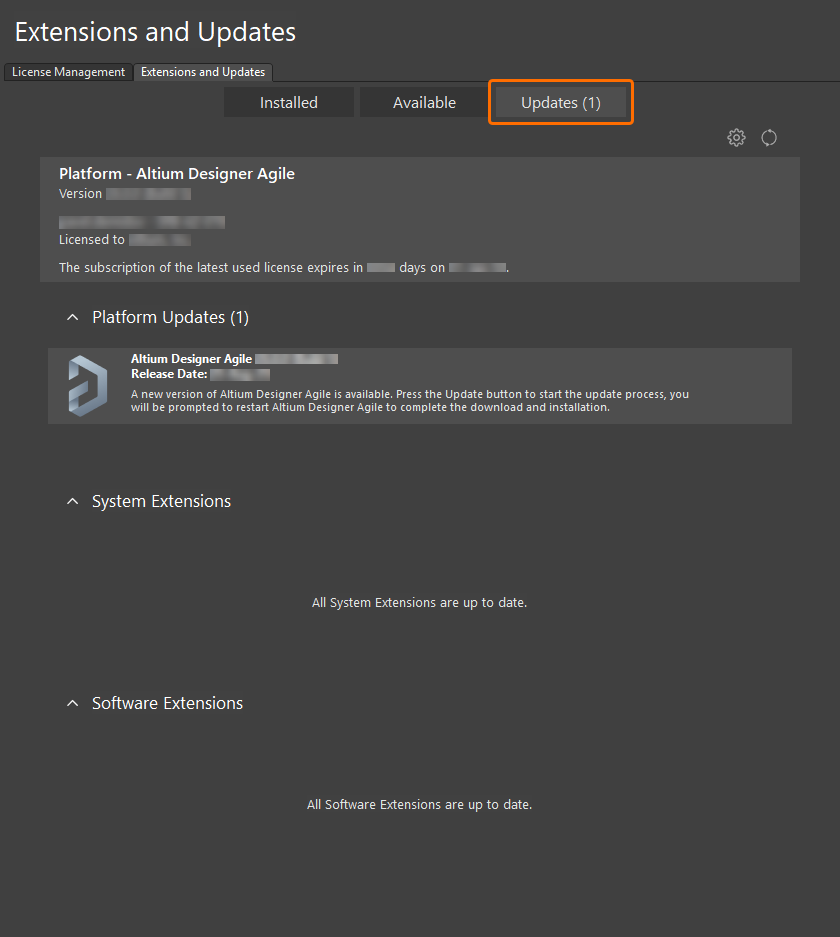
Browse whether the main platform has an update available.
 to refresh the update and license information or the
  to configure Altium Designer Agile’s installation and update notification settings. The latter opens the
 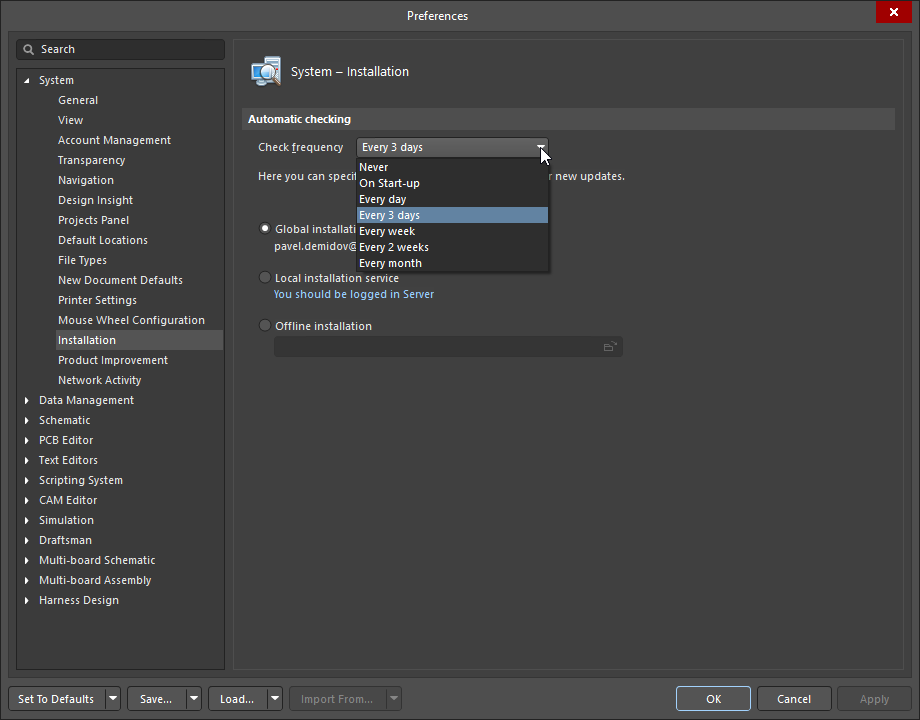 ).
).-
Access the Extensions and Updates view (click on the Current User control at the top right of the design space, then choose
 from the menu) and switch to the Updates tab.
-
In its Platform Updates region, the page presents all available Altium Designer Agile updates arranged in chronological order to provide a historical view of platform changes since the last update. The most recent version build incorporates the changes from all previous updates. To view further information on any platform update, click on the name to open a detailed view. In most cases, this will provide an expanded description of the update's function and Release Notes that summarize its changes over the previous version.
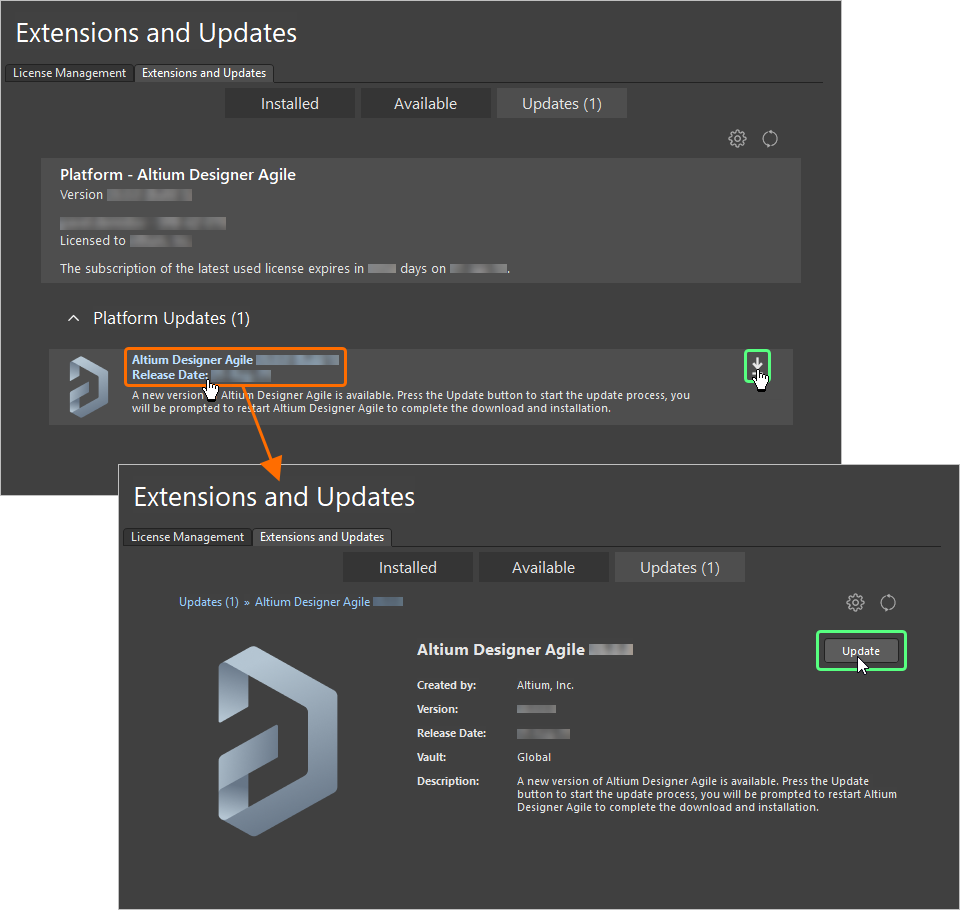
Update to a new version of Altium Designer Agile directly from within the current version. -
To download and install a software update listed on the summary-level Updates page, click its associated
 icon that appears when you hover the mouse cursor over the update entry name (hovering over the icon also reveals the version number of the new update). Alternatively, if browsing the detailed view for the update, click the
  button. If your license or subscription status does not allow the update, or you are not signed in to your Altium Account, a warning message will pop up to indicate the issue.
-
A progress bar will appear that shows the progress of the download (essentially getting the installer for the later version from the source repository). Should you need to cancel the update, click its associated cancel icon (
 ).
).
-
A confirmation dialog will open, alerting you that a restart is required to install the platform update; click Yes. The instance of Altium Designer Agile will close, and a window will appear showing progress in downloading and installing the files required to implement the update.
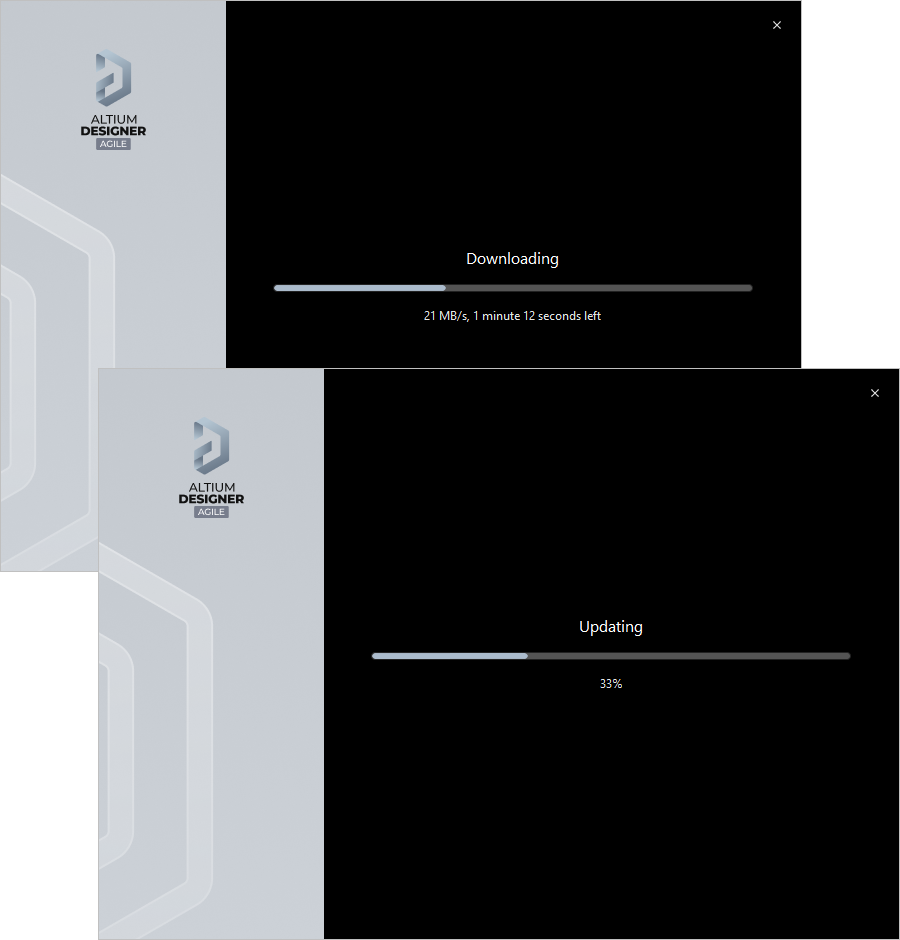
Update of the installation proceeds by downloading the files required to implement required changes to the software. Once downloaded, those files will be installed. -
Altium Designer Agile will then be restarted.
Updating from Windows
Updating your current instance of Altium Designer Agile to a later version is performed during installation of that later version.
-
Download and run the
AltiumDesignerAgileSetup.exefile associated with the latest version of the software. -
Follow the installation process using the Altium Designer Agile Installer for the new version. After agreeing to the Altium Designer Agile License Agreement and signing in, you will be presented with the page to choose the installation mode. This page gives you the choice of either updating an existing version instance of Altium Designer Agile or installing it as a separate new version instance. Choose the Update existing version option then use the drop-down field to select the specific instance of the software you want to update. The programs and documents install locations will be summarized based on the chosen instance.

Choose to update an existing instance of Altium Designer Agile during installation of a later version of the software. -
Click
 . The page will change, and the files required to implement the update will be downloaded and then installed.
-
The update to the installation is now complete. An option is provided to launch Altium Designer Agile when you exit the Installer, which is enabled by default. Click
 to exit the wizard.
Uninstalling
Uninstalling Altium Designer Agile is performed using the Altium Designer Agile Uninstaller. This wizard-based uninstaller is accessed from the standard Programs and Features page (accessed from the Control Panel). Right-click on the entry for Altium Designer Agile <Version> and use the Uninstall command from the context menu.

The Altium Designer Agile Uninstaller wizard will be presented.
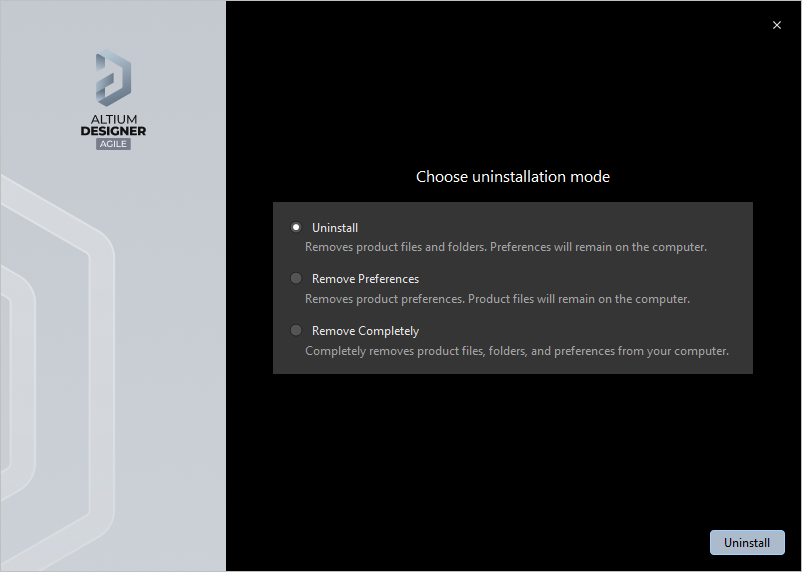
Uninstalling the software is streamlined, courtesy of the Altium Designer Agile Uninstaller.
Three actions are provided, facilitating varying degrees of 'uninstall' as follows:
-
Uninstall – removes the install folders (program files and shared documents locations) but leaves preferences-based folders alone. This enables you to have a build that is not currently installed, but whose preferences can still be reused, for example, by importing into another installed version.
-
Remove Preferences – removes just the preferences-based folders, covering system application data and security files, user application data files, and user local application data.
-
Remove Completely – total removal of the entire installation (i.e., installation folders and preferences folders).
Choose the uninstall action required. To proceed with the uninstall, click  . The page will change to show the uninstallation progress, and the chosen action will be processed. Once the uninstall is complete, click
  on the final page of the uninstaller.
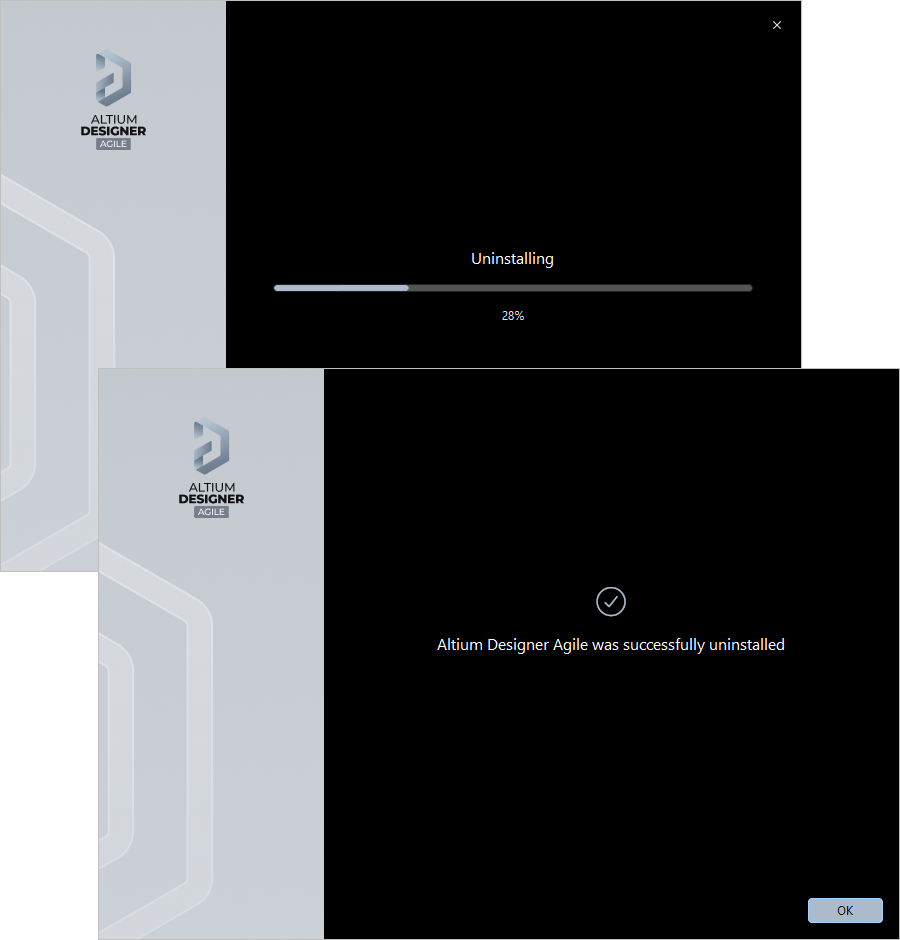
The Altium Designer Agile Uninstaller in action