
Requirements Portal
Iterate faster with a requirements management tool for engineering teams.
Stop Chasing Scattered Requirements
Capture and work with structured requirements without slowing down development.
Link Requirements to Designs & Verification
Connect requirements to systems, designs, and test cases for end-to-end traceability.
Share Requirements With Your Whole Team
Unlimited collaborators are included in the base subscription at no extra licensing cost.
Start Your Free 30-Day Evaluation.
No Credit Card Required.
Are you a student? Enroll in the Student Lab

Start in Minutes. Scale as You Grow
Import requirements from Excel, Word, or PDFs. The AI-assisted importer extracts and organizes your requirements into a structured workspace. Share them with your team and get value from day one. Start with what matters most — add traceability, verification, and version management when you're ready.

Requirements-Driven Development — Finally
Most teams want to become more requirements-driven, but don't have tools that fit their workflow. Requirements Portal guides you through the entire requirements process: capture intent, define and allocate requirements, coordinate implementation, plan verification, and generate compliance reports.

Keep Your Team Aligned on a Shared Spec
Requirements owners manage the spec. Implementation engineers see the requirements relevant to their discipline. Technical leadership tracks coverage and project health. Everyone stays connected as requirements and designs evolve in parallel, reducing late-stage surprises and rework.
Get Started with Requirements Portal
Create a workspace. Explore sample data. Invite your team. Try for 30 days for free.
Core Requirements Management Capabilities
Everything engineers need to manage requirements, verification, and traceability — in one workspace.
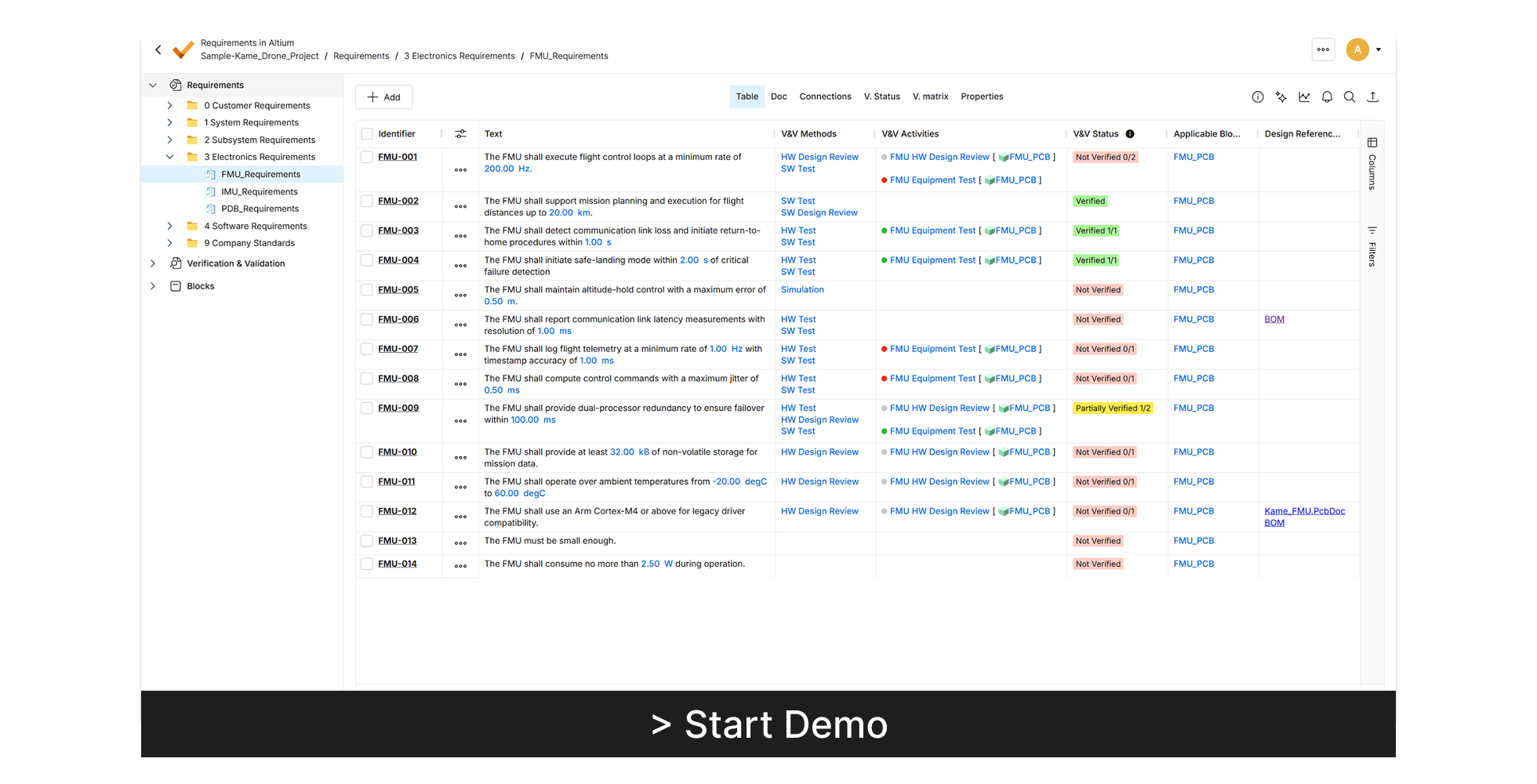
Manage & Share Engineering Requirements
Replace scattered documents with structured requirements in a secure cloud workspace. Give all engineers and stakeholders access to current requirements so they can make confident design decisions and iterate faster.
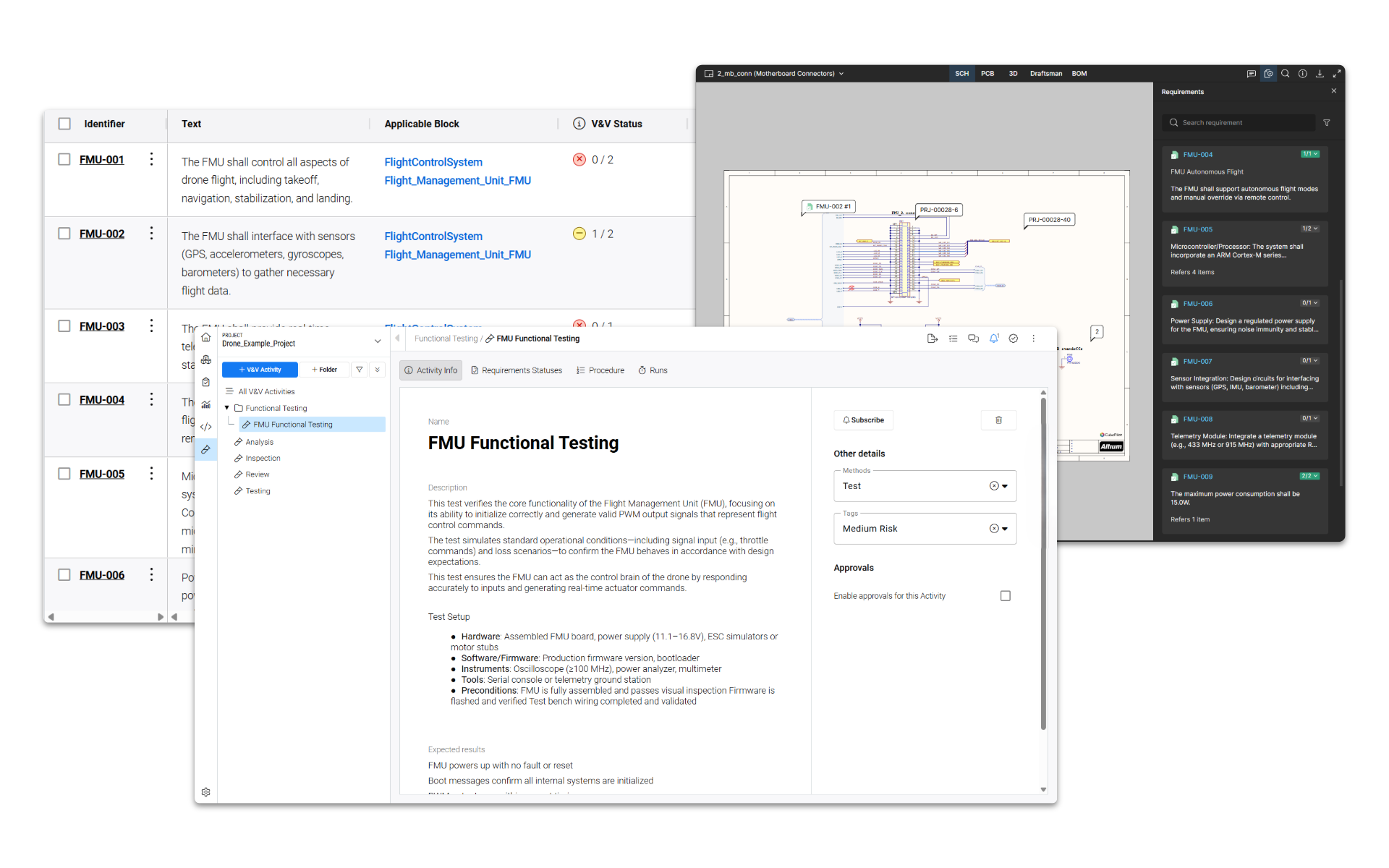
Plan & Track Verification and Testing
Centralize V&V activities and test cases in a cloud workspace to streamline verification. Link verification artifacts back to requirements to ensure full coverage and traceability — so your team catches issues before they become rework.
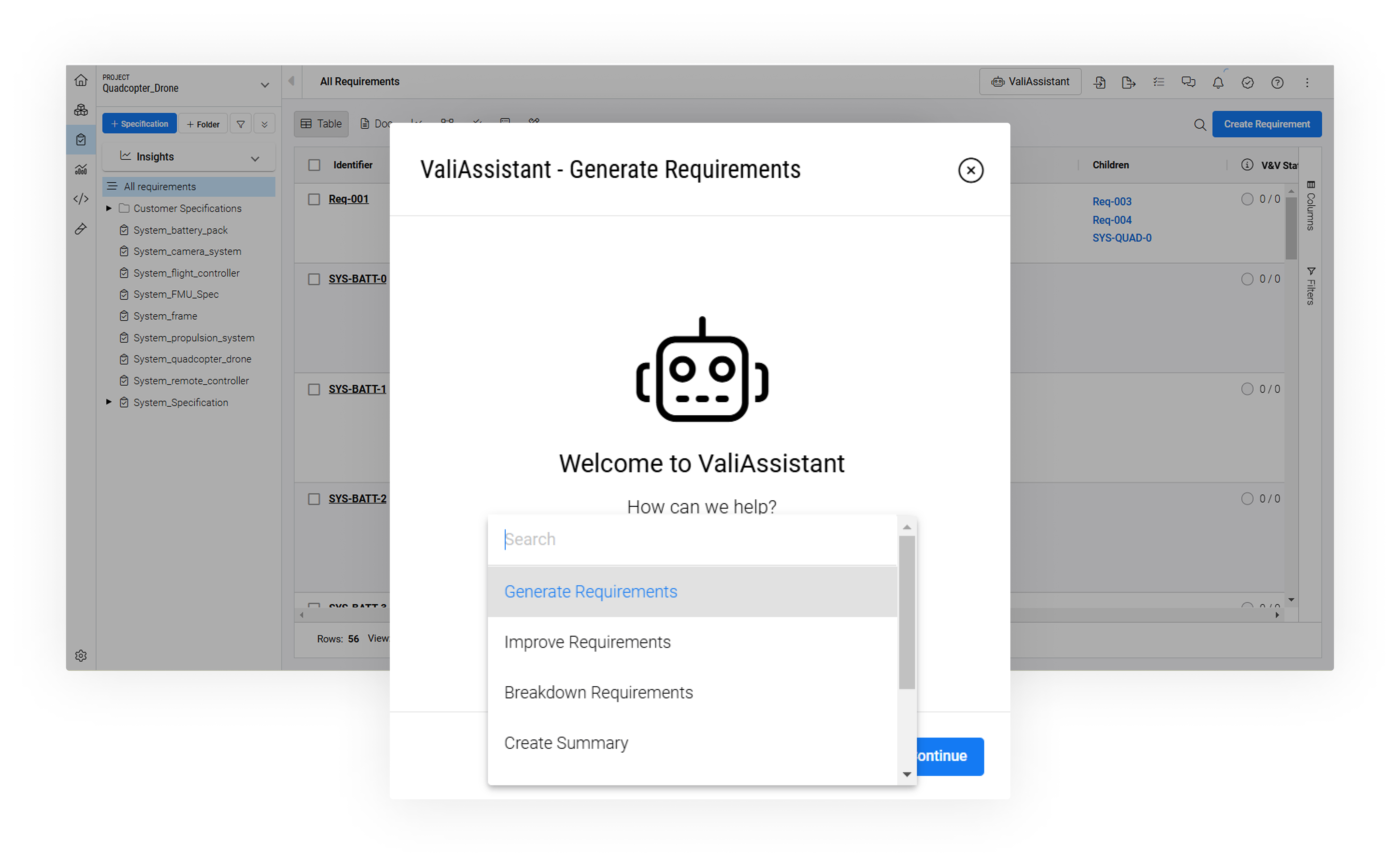
Speed Up Your Workflows with an AI Assistant
Use an AI assistant to import, analyze, and break down requirements to accelerate your workflow. Write clearer, verifiable requirements faster. The AI proposes changes for you to review and apply — the engineer is always in control.
Work With Requirements in Your ECAD Platform
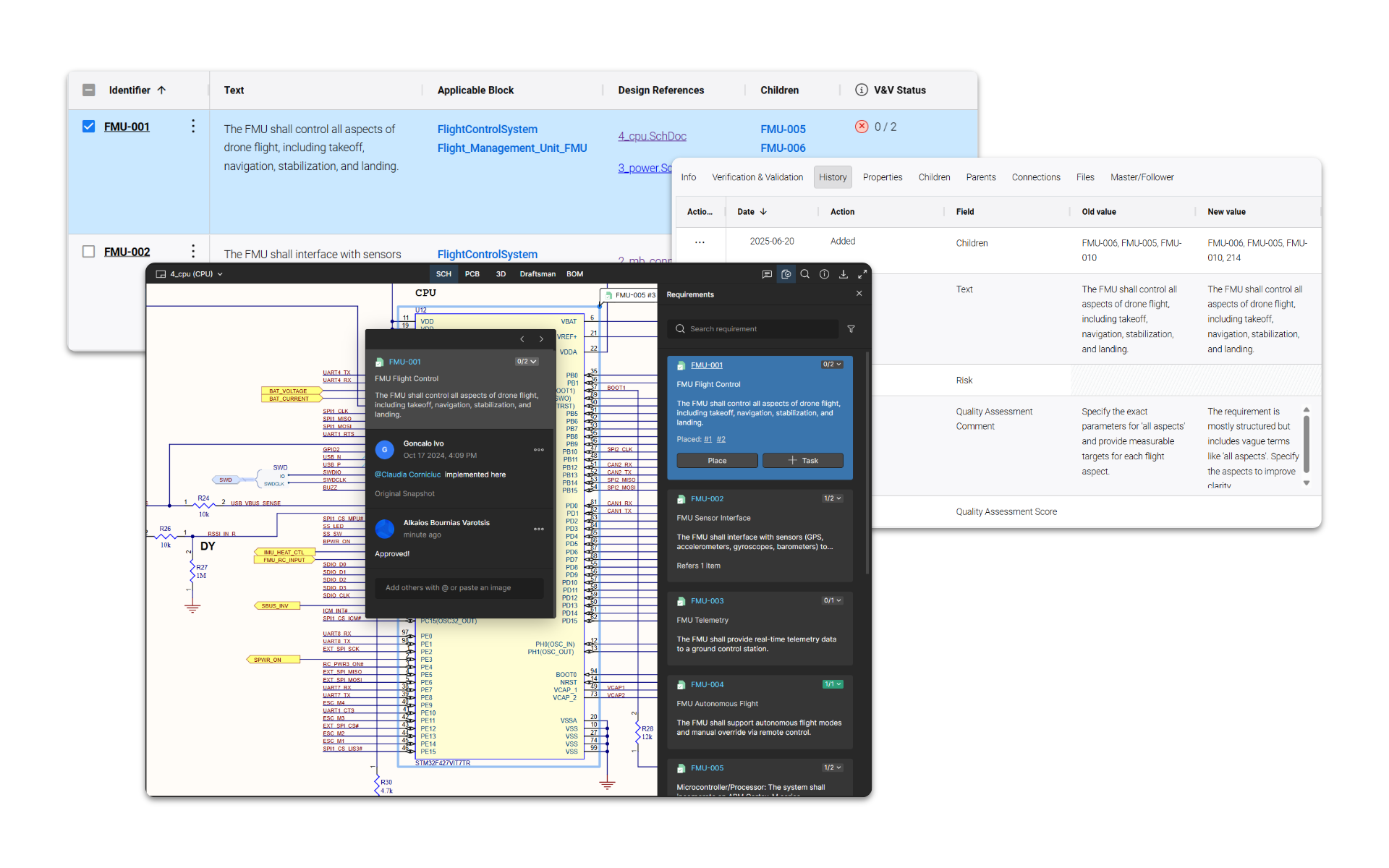
Link requirements to electronics projects in your Altium workspace. View and verify requirements alongside schematics and PCB layouts in the web browser or Altium Designer. Place them on components and BOMs for traceability and documentation.
See Requirements Portal in Action
Take a guided tour of the workspace. See how teams import requirements, trace them to designs, and track verification — in under 5 minutes.
Why Teams Choose Requirements Portal
More flexible than traditional requirements systems. More scalable than documents and spreadsheets.




Included in All Altium Subscriptions
Is your company using Altium products? You likely already have access to Requirements Portal.



For engineering teams getting started with structured requirements
For scaling organizations that need governance and process control
Requirements management

Requirements traceability
Requirements verification
Reusable parameters
AI assistant
Limited actions
Unlimited actions
Test case management
—
Customizations
—
Pricing
$995/year flat *
* Requirements Portal is included in the base Altium Develop workspace
Contact sales
For engineering teams getting started with structured requirements
Limited actions
—
—
$995/year flat *
* Requirements Portal is included in the base Altium Develop workspace
For scaling organizations that need governance and process control
Unlimited actions
Contact sales
For Teams Building Hardware Products
Create a common view of requirements your whole team will use — not just requirements experts.
Built for Requirements Owners
Systems Engineers · Technical Project Managers · NPD Team Leads
You need to capture intent, maintain alignment, and keep the process moving.
Requirements Portal helps you create a shared view of requirements with your team — without wasting time on admin.
- Manage requirements in a shared workspace to align your team
- Track changes and trace requirements to designs and verification
- Generate traceability matrices and compliance docs from live data
Built for Implementation Engineers
Electronics · Software · Mechanical · Verification · Procurement
You need clear, current requirements relevant to your discipline.
Requirements Portal gives you access to exactly what you need to understand, design, and verify the system you’re building.
- Stop chasing requirements in emails or outdated spreadsheets and docs
- See what applies to your discipline — with context and rationale
- Catch gaps and conflicts early to avoid late-stage rework and surprises
Built for Technical Leadership
Engineering Directors · Program Managers · VPs of Engineering
You need visibility into project health and compliance risks without chasing status updates.
Requirements Portal gives your team full visibility into project progress — reduce rework, iterate faster, stay compliant.
- Spot risks and gaps before they become late-stage surprises
- Replace meetings with real-time requirements visibility
- Switch to a tool that’s easy for your whole team to use
Key Features
Requirements Management

Manage requirements, verification, and test cases in a single shared cloud workspace accessible to all collaborators.
Verification & Test Management

Plan verification activities, create test procedures, schedule test runs, and capture evidence to ensure full coverage and traceability.
ECAD Integration

Give engineers constant access to clear requirements in the right context — status changes automatically sync across your project.
Traceability Graphs

Visualize stakeholder, system, and engineering requirements to better understand their connections and dependencies.
AI Requirements Assistant

Quickly analyze incoming requirements and break them down into clear engineering specifications with an AI assistant.
Live Dashboards & Analytics

Monitor project progress and requirement verification status with live dashboards to quickly identify and resolve noncompliant design issues.
Reusable Parameters

Turn numerical values in requirements into parameters that can be reused across your project for engineering calculations.
Continuous Verifications

Create verification rules that automatically compare system performance against functional targets specified in the requirements.
Smart Requirements Importer

Import unstructured requirements from XLS, PDF, or DOC files and convert them into structured data with an AI assistant.
Templated Document Exporter

Automatically generate compliance documentation and traceability matrices from live project data for audits and handoffs.
Change History

Automatically track requirement changes with full version history. Review past edits, keep teams aligned, and ensure traceability and compliance.
Comments & Tasks

Engage your team’s experts in requirement review and implementation processes to arrive at the best possible specifications and solutions.
Common Questions
Requirements Portal is Altium’s requirements management tool that enables engineering teams to create, manage, and trace requirements across systems, designs, and verification activities. It is included in Altium Develop, Altium Agile Teams, and Altium Agile Enterprise subscriptions.
Requirements Portal is designed for systems, hardware, firmware, and verification engineers developing complex products that require structured requirements management with end-to-end traceability.
Whether you are designing PCBs or developing complex smart products, Requirements Portal lets you keep track of your requirements and their verification.
Yes. You can try Requirements Portal for free by starting a free 30-day evaluation of Altium Develop or Altium Agile Teams.
Requirements Portal is included in Altium Develop, Altium Agile Teams, and Altium Agile Enterprise subscriptions. Altium Develop pricing starts at $995 per year and includes unlimited collaborators at no additional cost. Collaborators can create, view, and edit requirements. You don’t need Altium Designer Authors seats to use Requirements Portal.
Requirements Portal is included in all Altium subscriptions — including Altium Develop and Altium Agile Teams.
In other words, if your company uses Altium products, you already have access to Requirements Portal.
Altium Develop is designed for individuals and small teams. It includes a cloud workspace subscription, optional concurrent author seats for Altium Designer, and unlimited cloud collaborators.
In Altium Develop, Requirements Portal includes all core functionality needed to manage engineering requirements for complex hardware products, including:
- Requirements management projects
- Requirements traceability
- Requirements verification
- Smart import & templated export
- AI requirements assistant
- Parametric requirement
Altium Agile Teams builds on the same core foundation as Altium Develop and adds capabilities for growing organizations.
In Altium Agile Teams, Requirements Portal adds capabilities for managing product families and adapting the tool to company-specific processes, including:
- Unlimited AI assistant actions
- Advanced user permissions
- Test case management
- Custom requirement fields and export templates
- Requirements lifecycle management (coming soon)
- Workflows and automations (coming soon)
Getting started with an evaluation of Requirements Portal is easy:
- Create your Altium account.
- Activate your Altium Develop workspace.
- Invite teammates to your workspace.
- Explore Requirements Portal and the other capabilities of Altium Develop.
Here's some tips to get started once you're in Requirements Portal:
- Explore the Demo Data
Your workspace comes equipped with sample data. Explore the Drone_Example_Project to learn more about the core use cases of Requirements Portal.
- Create a New Project
Use the example project as a reference to create your own requirements project. Add requirements, system blocks, and V&V activities.
- Import or Create Requirements
Drag and drop an Excel, PDF, or Word file containing requirements into the importer, or use the AI assistant to generate requirements.
Requirements Portal is the successor to Valispace. After Altium acquired Valispace, its technology was integrated into the Altium ecosystem and evolved into Requirements Portal.
Ready to Try Requirements Portal?
Included in Altium Develop and Altium Agile Teams. No credit card required. No extra licenses for your team.