

Altium Customer Success
How Glassboard connects clients and engineers with Altium Agile Teams
“This unification of getting feedback quickly allows a much larger team to work on bigger projects, just as fast as we used to when we were a couple of people all in the same room.”
Glassboard brings clients and multidisciplinary engineers into a shared development process, using Altium Agile Teams to keep feedback close, design data accessible, and projects moving.
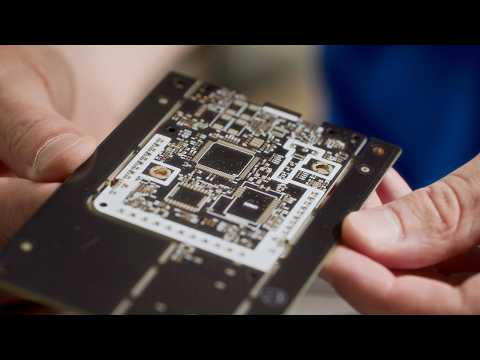
At Glassboard, an idea can move from an industrial designer’s sketch to a mechanical enclosure, an electrical design and embedded software in a matter of days. Turning those contributions into one working product takes more than individual expertise. It takes a team that can see what is changing, review it in context, and keep the idea moving together.
The Indianapolis hardware development firm develops physical products for clients ranging from small startups to enterprise organizations. Its work spans consumer products, medical devices, connected hardware and mobility. As the business has grown, the challenge has been to preserve the speed and openness of a small team while coordinating more disciplines, more partners and more complex projects.
A shared design, with feedback where it belongs
Glassboard’s engineers need input from colleagues who do not spend their days inside an electronics design tool. Managers review circuit designs. Embedded software engineers investigate pin assignments and test points. Mechanical engineers check how a board fits inside an enclosure. Technical clients want to understand decisions while there is still time to influence them.
Using the Altium Platform, Glassboard can bring those contributors into the design through a browser. Reviewers can examine schematics, PCB layouts, and 3D views, then leave feedback in the relevant place. The team spends less effort translating comments back into engineering context.
“The ability to give feedback to the design engineers natively in the design is super important. So if I've got a comment to put on a schematic, I can go to the schematic view and drop that comment directly in that view.”
The process also gives feedback ideas a path to realization. Drew describes moving review tasks through to-do, in-progress, and done, with a final check that the requested changes were made. This adds structure to frequent collaboration without forcing the team to wait for every question to become a formal meeting.
Clients can participate too. Glassboard selectively shares designs and projects with technical clients so they can see progress and contribute directly.
“For some of our more technically sophisticated customers and clients, we will give them direct access to the web portal to conduct design reviews with us, or to actually just comment directly on a design. And so they're able to be brought into that process in a really low-friction way.”
Client ambition, paired with multidisciplinary execution
Glassboard recently collaborated with a client called ClearObject. ClearObject’s roadside safety pilot brings the value of this multidisciplinary approach into focus. The company had developed a vision system to detect potential hazards in a work zone. It needed a way to carry an alert from that system to the people working nearby.
Glassboard helped develop a wearable device that could provide visual, audio, and haptic alerts. The challenge extended beyond putting electronics in a mechanical housing. The device needed to work with how people actually move through a construction site, attach to a vest or helmet, support charging, and stand up to the demands for use outside a lab.
Electrical, mechanical, industrial design, and embedded software experts needed to work together in parallel. A change to an enclosure could affect the board. A change to the electronics could affect the firmware. Shared access to the current design helped prevent one discipline from waiting on another before they proceeded.
Mechanical engineer Brady Kakert describes retrieving the latest board revision from Altium and bringing it into Onshape to check it against his enclosure design. On a project timed around a construction season, that access mattered even when an electrical engineering colleague was away.
For embedded software engineers, shared access is useful at the workbench as well as during design. Embedded software engineer Luke Welch can follow a net from the schematic into the PCB and 3D views to locate the hardware he needs to test. Release history lets him look up the design corresponding to the particular board in front of him.
“Being able to open up releases is super useful so that I can jump back to exactly the hardware that I am testing on, as opposed to whatever the latest is that I can find.”
Keeping the next build connected to the design
Glassboard’s design-build-test-iterate approach depends on making prototypes quickly enough to learn from them at the pace of the client’s timeline. Some early boards are still assembled by hand, even though the firm has a pick-and-place machine. For very small quantities, the engineers describe hand assembly as the faster route to the first board for testing.
Altium’s Assembly Assistant helps them work through component placement and compare the resulting physical board with its digital representation.
“Once I'm done with my build, I can really easily visually compare the board that I have in front of me to the software and make sure I didn't miss any components.”
The same emphasis on reusable, connected data appears earlier in the process. Managed components can be reused across projects instead of recreated for each design. Component availability and lifecycle information help the team spot sourcing concerns while it can still act on them. Drew describes using that visibility to secure parts for prototyping and early pilot production.
Design revisions and manufacturing outputs remain connected, making it easier to understand which files produced a physical board and then to hand a project over for the next step.
“And so all of that data living within a single ecosystem and revision controlled is an absolute game changer.”
Growing the team without slowing the feedback
For Glassboard, Altium supports a broader way of working across projects: open access for the right collaborators, feedback tied to the design, reusable components, and a clearer connection between revisions and builds. Those practices help a growing firm preserve the rapid exchanges that made its small team effective in the first place. The resulting agility allows the team to complete more hardware development services to more clients, while maintaining a superior level of quality.
Watch the full video: https://youtu.be/1-SUS0xIMBk