

Requirements Portal vs. Jama
Manage structured requirements while moving fast
Requirements Portal is built for hardware engineering teams that need structured requirements — without the overhead. Traditional requirements tools like Jama are built for organizations with dedicated requirements engineers, formal processes, and multi-month rollouts.
- Capture, trace, and verify — your whole team included
- Link requirements to designs and verification
- Included in every Altium subscription — try it today
Which Requirements Tool Fits You?
Select a workflow from the list below to see how Requirements Portal compares to Jama.

Drop in requirements from anywhere, get structured requirements out. Requirements arrive how they arrive — Excel, PDF, Word, email. The AI Importer in Requirements Portal turns those files into structured requirements you can review, edit, and act on. Your whole team works with them from day one, with unlimited collaborators included in every subscription.

Jama is built as systems of record, with formal baselines and change-control at the core. That's the right model for governance, but it's heavy for the messy early prototyping phase — setup takes time, the interface assumes specialist training, and iteration slows down before the spec is even stable.
Trial Tip: Drop a PDF or spreadsheet into the AI Importer and see how it structures those requirements.
You can run real systems engineering without a full modeling stack. Requirements Portal walks you from stakeholder requirements down to system, sub-system, and component levels — with breakdown and allocation as you go. Build system blocks in parallel, allocate requirements to them, and use parametric values to drive your calculations and verification checks.
For full Model-Based Systems Engineering (MBSE), Jama connects to third party tools like Capella and Enterprise Architect. However, such capabilities are only useful if you have a mature systems engineering function and the resources to create and maintain these heavyweight models.
Trial Tip: Build a simple architecture and link system block them to requirements and Altium projects.
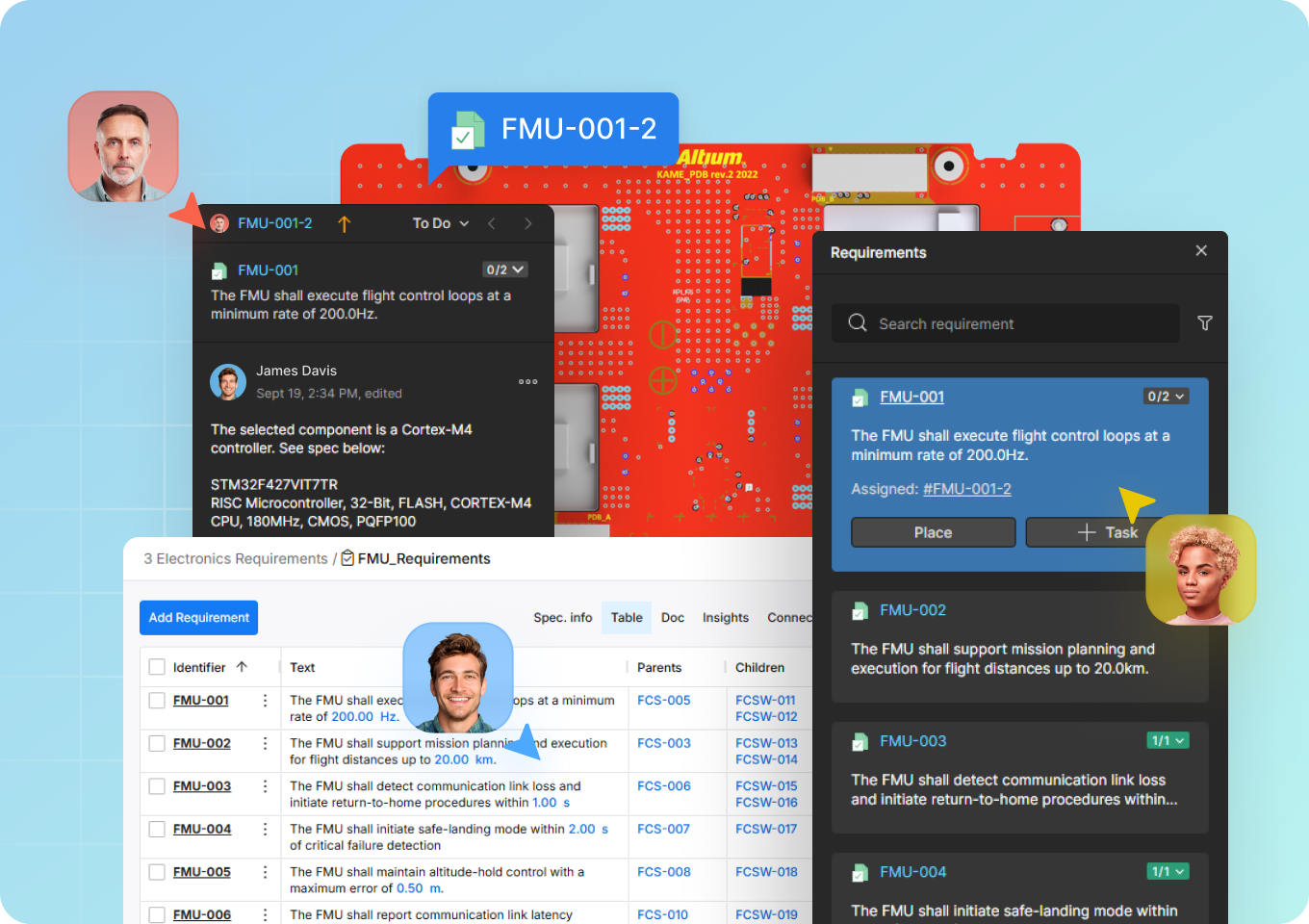
Requirements should be visible where design decisions happen. With Requirements Portal, engineers see them alongside schematics and BOMs inside Altium Designer. Notifications, comments, and reviews surface changes to mechanical, firmware, and verification teams the moment something moves — before it causes rework.
Requirements in Jama live separately from hardware design. The gap shows up in practice: engineers design against outdated specs without realizing it, and impact analysis turns into a manual exercise across two systems.
Trial Tip: Link a requirement to an Altium project and verify implementation from inside the schematic.
Verification is a first-class activity in Requirements Portal, not an afterthought. Plan verification activities, define methods, build test procedures step by step, link requirements down to individual procedure steps, and capture evidence as you go. Audit-ready outputs come from live project data, without a separate report-building task.
Jama is built for enterprise-scale V&V — formal sign-off workflows, deep automation hooks, and thousands of test cases. They make sense when verification is its own program with dedicated headcount, when it isn’t a workstream the engineering team owns alongside design.
Trial Tip: Build a verification activity with a test procedure, linked requirements, and attached evidence.
Audit prep is a continuous output, not a separate project. Requirements Portal generates traceability graphs, audit packs, and compliance documents from live project data, with your own export templates for handoffs. That covers customer audits, and most of the engineering compliance work that hardware teams must do by hand.
For ASPICE, DO-178C, ISO 26262, or IEC 62304, Jama offers pre-built templates and formal Review Centers with electronic sign-off. This might be the right call when those standards are baseline expectations and your auditors expect the format out of the box. Otherwise, the excess structure takes up time and limits your flexibility.
Trial tip: Generate a traceability matrix. Learn how to customize the templates to match what you need.
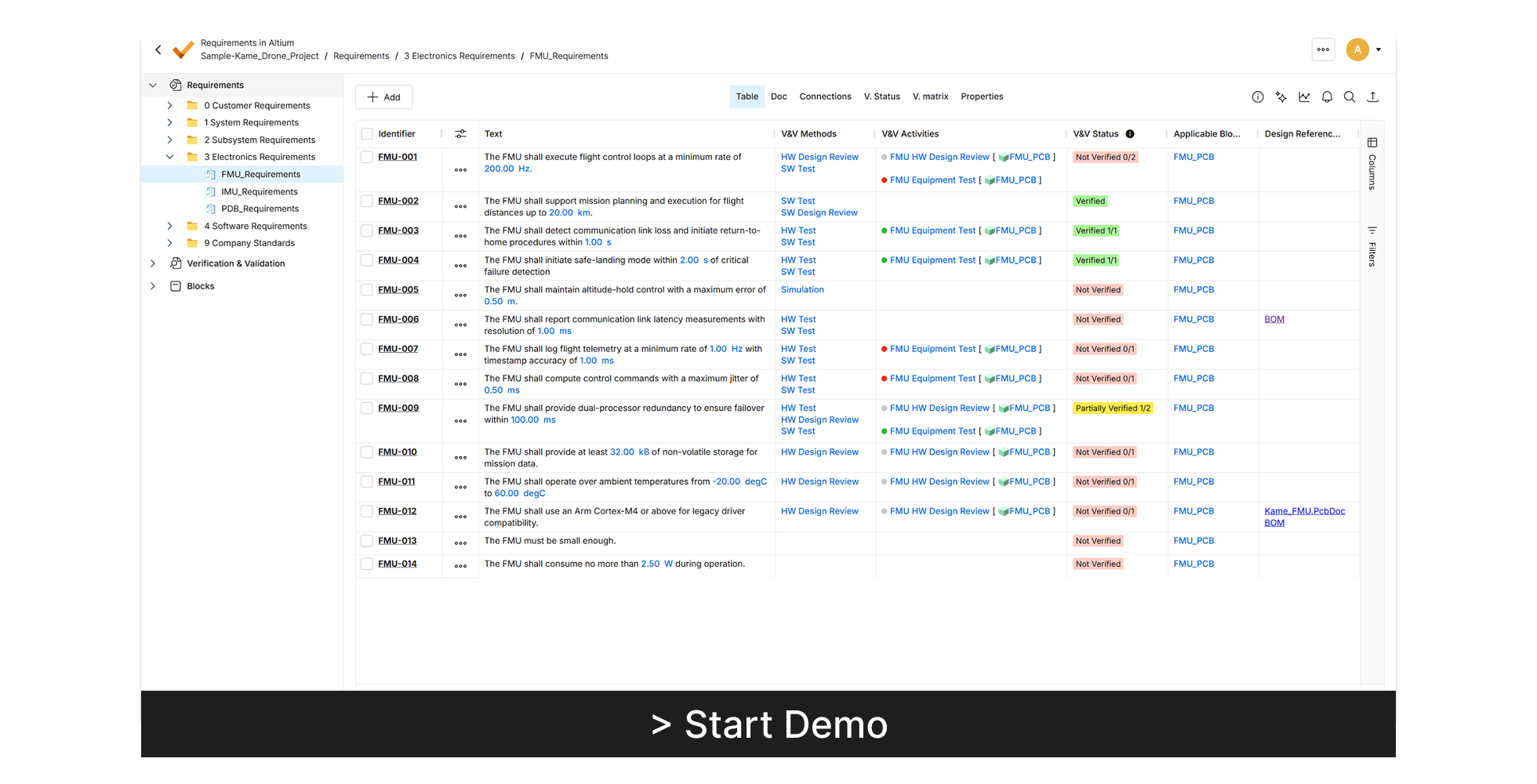
Take a Tour of Requirements Portal
See the tool in action. Learn how Requirements Portal helps your team:
- Create a shared view of requirements
- Work with requirements alongside Altium projects
- Ensure end-to-end requirements traceability
- Manage verification activities and test runs
- Generate documentation
Match the Tool to How Your Team Works
Choose Requirements Portal to balance speed and traceability. Choose traditional requirements management tools when governance is the priority.
For Enterprises Demanding Governance
Built for enterprise scale and formal control.
- You can absorb a multi-month rollout and admin overhead.
- Your organization has resources for a dedicated requirements function.
- You run formal model-based systems engineering with SysML.
- Verification is its own program with multistage structures and sign-offs.
- You operate in an industry where pre-audited templates are mandatory.
- You’re ready for a multi-vendor toolchain and enterprise licensing costs.
For Hardware Teams That Iterate Fast
Structured requirements for agile engineering.
- You're moving beyond spreadsheets to a structured requirements tool.
- Your work spans electronics, mechanical, firmware, and verification.
- You need structure for requirements and systems — but not a full modeling stack.
- Hardware, firmware, software, systems, and testing are connected functions.
- You need compliance documentation exported on demand.
- You're using Altium — Requirements Portal is included.
Why Teams Choose Requirements Portal
More flexible than traditional requirements systems. More scalable than documents and spreadsheets.






Common Questions
Learn more about Requirements Portal and Altium's solutions.
Requirements Portal is Altium's requirements management tool for engineering teams developing hardware products. It allows team members to capture stakeholder needs, break them down into system and sub-system requirements, allocate them to design and verification, and trace everything end to end. This all happens in a shared cloud workspace, as many collaborators as needed. Requirements Portal is included in Altium Develop and Altium Agile Teams subscriptions.
Systems, hardware, firmware, and verification engineers working on complex hardware products can use Requirements Portal for structured requirements management without the overhead of traditional tools. Requirements Portal lets teams move beyond spreadsheets and shared documents, providing traceability without a multi-month rollout or specialist training.
Yes. Requirements Portal scales in three dimensions:
Data: Requirements Portal can handle projects with thousands of requirements with full traceability, proven on real aerospace and space programs.
Team: Subscriptions accommodate hundreds of collaboration users, so adding people doesn't add per-seat cost.
Process: When formal governance becomes the priority, Altium Agile Teams adds custom workflows, advanced permissions, test case management, and lifecycle management.
Requirements Portal is included in every Altium Develop and Altium Agile Teams subscription. Jama is quote-only with per-seat licensing, typical floor pricing in the four-to-five-figure range per year before implementation services, and average rollouts that run multiple months. The total cost of getting started is the difference between starting a 30-day evaluation today in Altium and starting a lengthy procurement cycle for those other solutions.

Built into the Altium Platform
Requirements is only part of the job.
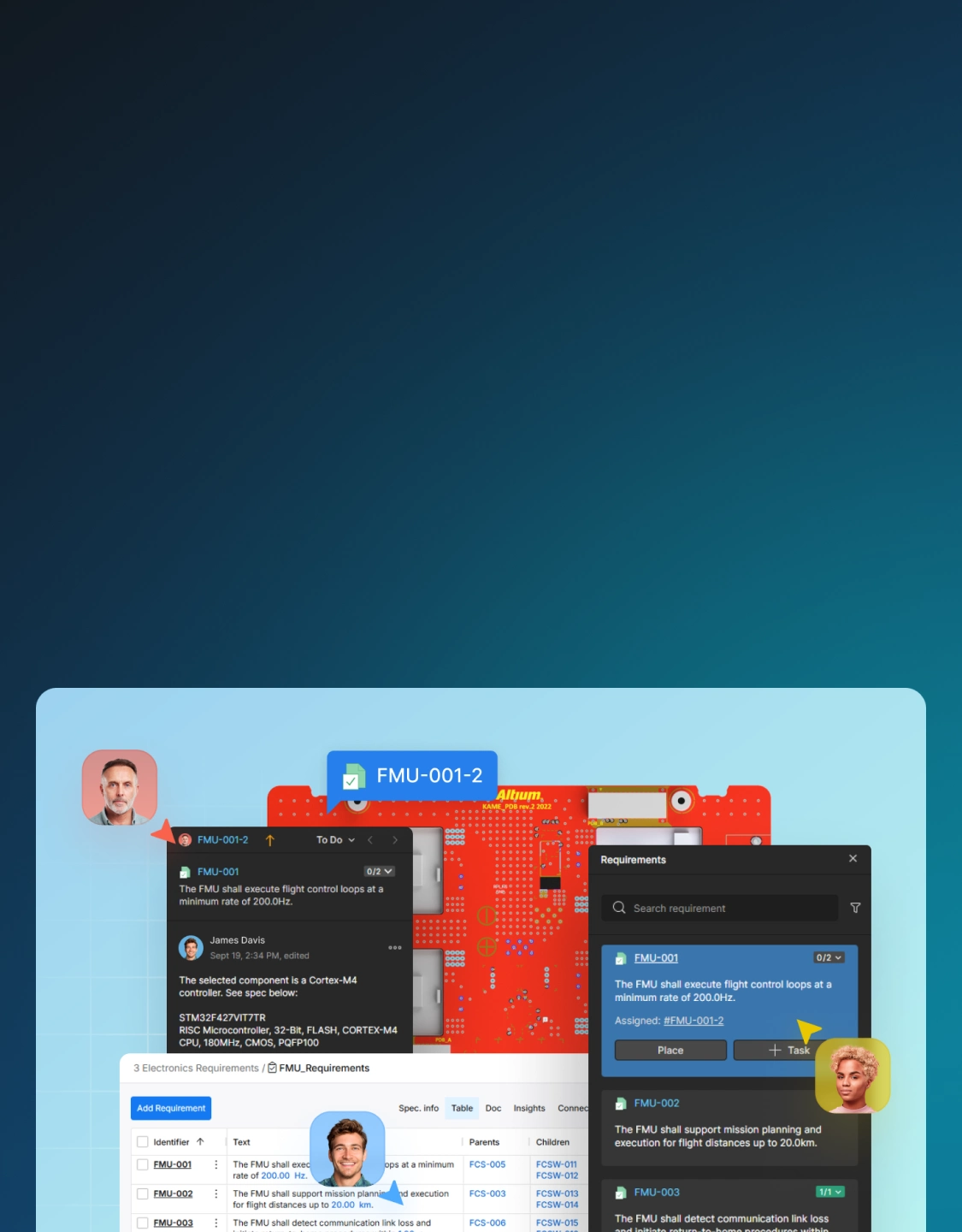
Altium Agile Teams
Engineering teams design boards, manage components, share work with stakeholders, and collaborate across disciplines.
Requirements is one capability of Altium — the same platform-based solution handles your schematic capture, PCB layout, component sourcing, and team collaboration.
Design
Work with requirements alongside schematics and PCB layouts in Altium Designer or the web browser to support your full electronics design workflow.
Team Management
Centralize project context for design data, change history, tasks, and reviews. Every contributor stays aligned with the team’s progress and moves forward without unnecessary check-ins.
Requirements
Keep requirements visible, structured, and tied to design context. This allows contributors to see only what they need and respond to changes that affect them.
Supply Chain
Bring real supply-chain intelligence into each design phase, helping teams catch risks, evaluate alternatives immediately, and avoid last-minute sourcing problems.
Data
Enforce lifecycle states, prevents conflicts, and maintains a complete audit history so that every artifact remains clear, current, and trustworthy.


Contact Us
to Get Started
Requirements Portal is included in Altium Agile.
Altium Agile is a platform-based solution for electronics, products, and systems development, delivering control without complexity.
Start Your Free 30-Day Evaluation
Fill out the form to contact our sales experts.
Learn more about Requirements Portal and Agile Teams.
Are You A Student? Enroll in the Student Lab