
Altium Customer Success
D-Orbit Builds a Connected Engineering Foundation for the Future of Space Logistics with Altium Enterprise
"We are creating infrastructure. Like roads, highways, and facilities allow people to move on Earth. We are creating the same kind of infrastructure in space."
Discover how D-Orbit, a leader in space logistics and orbital transportation, is connecting electronics development across its broader engineering enterprise.
Discover how D-Orbit, a leader in space logistics and orbital transportation, is connecting electronics development across its broader engineering enterprise.
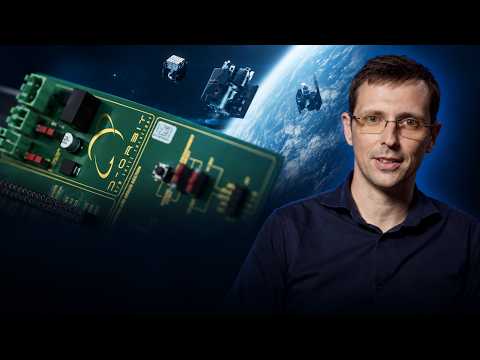
By adopting Altium Enterprise and working closely with Altium Enterprise Professional Services, D-Orbit is integrating electronics design with PLM, mechanical engineering, manufacturing, procurement, and component intelligence, creating a more traceable, scalable, and efficient foundation for mission-critical space systems.
- One Source of Truth for Mission-Critical Electronics
- Connected Engineering from Design to PLM
- Faster Prototyping Without Losing Control
- Earlier Visibility into Component and Supply Chain Risk
- Speed, Reliability, and Compliance for the New Space Market
D-Orbit is helping build the infrastructure for the next era of the space economy.
Founded with a vision for space sustainability, D-Orbit develops space logistics and orbital transportation systems that help make orbit more useful, accessible, and sustainable. The company’s work began with a clear problem: as more satellites are launched, space becomes more crowded, and end-of-life spacecraft can turn into debris if they are not properly removed or managed. According to the European Space Agency (ESA), the Earth's orbital environment is a finite resource and the amount of space debris in orbit continues to rise quickly. Approximately 40,000 objects are now tracked by space surveillance networks. However, it is estimated that over 1.2 million pieces of space debris larger than 1 cm in size, are in orbit and they are capable of causing catastrophic damage." (source ESA.int)
Today, D-Orbit is expanding their vision into a broader logistics infrastructure for space. Its ION Satellite Carrier transports satellites and payloads into orbit, deploys customer spacecraft into the right operational positions, and can host payloads by providing power, data, and communication capabilities. Looking ahead, D-Orbit is also working toward a future where space assets can be moved, serviced, refueled, refurbished, and kept operational for longer.
For D-Orbit, this work is about more than launching technology into space. It is about creating the infrastructure that will make space more accessible, useful, and sustainable.
“You can’t patch a board once it is in orbit. Catching issues early in the schematic or layout stage is not optional. It is a necessity.”
That mission comes with extreme engineering demands. Space systems bring together mechanical structures, electronics, firmware, software, propulsion, power, thermal systems, communications, manufacturing, quality, procurement, and compliance. Every discipline depends on trusted data from the others, and every decision can affect mission success.
As D-Orbit continues to scale in the New Space economy, the company needed a more connected foundation for electronics development—one that could support governance and compliance needs, collaboration, speed and confidence across the full engineering lifecycle.
Connecting Engineering Across a Complex Space Systems Environment
Building spacecraft requires more than skilled engineering teams. It requires processes, systems, and data that can move across disciplines without losing context.
D-Orbit uses a broad engineering software environment that includes requirements management, PLM, ERP, mechanical CAD, electronic CAD, modeling, simulation, and other specialized systems. For that environment to support mission-critical development, data needs to flow reliably from one domain to another.
“The data should be available to anyone who needs to work with that data,” Vallini said. “The team and the tools need to be interconnected to enable mission success.”
To support this connected way of working, D-Orbit adopted Altium Enterprise as a central part of its electronics development infrastructure.
"Altium plays a key role in establishing this integrated development infrastructure."
Integrating Electronics Development with PLM
A key part of D-Orbit’s implementation was connecting Altium Enterprise with Windchill, the company’s PLM system. This allowed D-Orbit to integrate electronics design into its broader enterprise architecture while preserving its preferred PLM-centered workflow.
Rather than forcing a rigid process, Altium Enterprise supported D-Orbit’s operating model. Electronics data could be created in Altium, shared through Windchill, connected to Creo mechanical workflows, and released into the company’s PLM process for downstream teams.
“If something goes wrong in a consumer product, you can recall it or replace a part. Here, we can’t recall the product when it is over our heads. For that reason, the design phase must be very, very careful.
This connected workflow gives D-Orbit a more reliable way to manage design data from electronics development through manufacturing. When a project is released, the relevant design files, manufacturing outputs, and bill of materials can be made available to the departments that need them.
“There is only a single source of truth,” Menini said. “Information is collected in a single place and shared to all departments every time.”
That single source of truth helps reduce manual handoffs and version uncertainty. Instead of relying on email, shared folders, or static exports, teams can access current, controlled information through the connected workflow.
“You avoid sharing data with suppliers that is not updated,” Menini said. “We are 100% sure this is the right information to share.”
Bringing Component Intelligence into the Design Process
For space systems, component selection affects more than electrical performance. It influences availability, lifecycle risk, manufacturing readiness, procurement timelines, and long-term reliability.
Before moving to Altium Enterprise, D-Orbit’s component library and sourcing workflows relied on more fragmented sources of information. Engineering, ERP, and procurement teams could end up working from different views of component data, and availability or obsolescence concerns could appear late in the process.
With Altium Enterprise and component intelligence capabilities, D-Orbit can surface supply chain and lifecycle information earlier—while engineers are still making design decisions.
“When the design starts, the hardware engineer can have a look at the availability of the components on the market,” Menini said. “Not at the end, when you have a preliminary bill of materials and move to your EMS.”
This earlier visibility helps D-Orbit avoid selecting components that may be obsolete, not recommended for new designs, difficult to source, or risky for manufacturing. It also brings engineering and procurement closer together around shared component data.
For Menini, this is valuable beyond the electronics team.
“This is an instrument that is not useful just for engineers, but also for other departments inside the company,” he said.
“We really appreciate that Altium was suitable for our idea of PLM-based design. They provided the right interface and helped us develop ECAD-MCAD collaboration through PLM.
Accelerating Development with Greater Confidence
In the New Space market, speed matters. D-Orbit needs to prototype, test, qualify, and launch new technologies quickly—without sacrificing reliability or traceability.
By connecting electronics design with PLM, component intelligence, release workflows, and cross-functional collaboration, Altium Enterprise helps D-Orbit reduce time spent searching for data, reconciling versions, manually sharing outputs, and resolving issues late in the process.
“Using Altium Enterprise, we are able to be more efficient,” Menini said. “If the prototyping phase is faster, the hardware engineer can test his board faster. We have more time to develop new boards.”
D-Orbit also worked closely with Altium Enterprise Professional Services to design and implement the connected workflow. For D-Orbit, the relationship was not just about deploying software. It was about building an engineering foundation that fit the company’s processes and long-term goals.
“They are not a supplier; they are more a partner,” Menini said. “They helped us reach the target. That was something strategic and very important for D-Orbit.”
As D-Orbit continues advancing space logistics and orbital transportation, Altium Enterprise helps provide the connected engineering foundation behind that mission—linking electronics development with the people, systems, data, and decisions needed to move faster with greater control.
“We use Altium because it is integrated into the company process, and it helps us,” Menini said. “It is an instrument that works for the team.”