
Altium Customer Success
Quantum Systems Scales Autonomous Drone Development with Altium’s Solutions
“We wanted to grow in professionalism, we wanted to grow in complexity, so we needed something that would be able to handle all that. For me, it was clear that Altium was the right tool to do that. In Altium 365 we have all the information we need—we don’t have to look it up, it’s all there.”
Discover how Quantum Systems unified design, collaboration, and procurement workflows in Altium to support autonomous drone development at scale.
Discover how Quantum Systems unified design, collaboration, and procurement workflows in Altium to support autonomous drone development at scale.
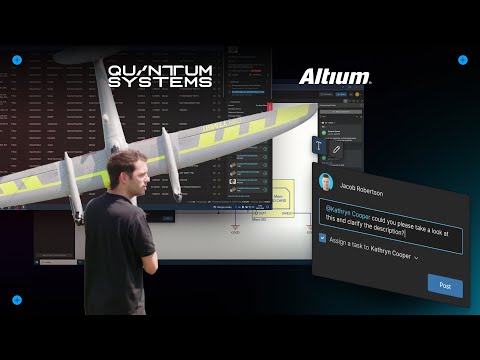
Quantum Systems operates at the intersection of deep tech, embedded engineering, and autonomous systems, developing drone platforms designed to deliver aerial intelligence across industries such as public safety, agriculture, and infrastructure monitoring. Their long-term vision extends beyond hardware: they’re working toward a model where drones function as an on-demand service. A user defines a task, the system deploys a drone automatically, collects the required data, and returns home.
Delivering this vision requires integrating a highly sophisticated embedded system. Each drone combines avionics, onboard AI processing, sensors, and storage across roughly 15 interconnected PCBs. At the same time, Quantum must coordinate electronics design, procurement, embedded engineering, and production workflows as their platform grows in complexity.
To support this, Quantum Systems adopted Altium, leveraging Altium Designer for PCB design and Altium 365 as a shared collaboration platform. Together, these tools provide a connected environment that enables teams to work from a single source of design data while managing the growing complexity of both the product and the organization.
Addressing Engineering Time Lost to Design Clarification
As Quantum’s drone platform evolved into a multi-board system integrating avionics and AI compute, the volume of design information and the number of stakeholders depending on it grew significantly. Engineers across disciplines needed access to detailed design context to perform their work effectively.
Without a centralized system, design leads became a bottleneck. Time that should have been spent advancing system architecture was instead devoted to answering questions, clarifying design intent, and walking others through implementation details.
By implementing Altium, Quantum centralized their design data in a secure Workspace, making schematics, PCB layouts, BOMs, and other release information directly accessible to the broader team from a browser. This reduced reliance on individual engineers for explanations and allowed stakeholders to find the information they needed independently.
“If I didn’t have all the tools that Altium provides me now, more or less a quarter of my week would be clarifying questions or talking about designs and explaining stuff. With Altium 365 that rapidly changed, and I can now be more on a top-level design process.”
Quantum’s development workflow spans multiple domains, each requiring different perspectives of the same design data. Electronics engineers, embedded developers, procurement teams, and assembly specialists all interact with the product in different ways, but must remain aligned to avoid inconsistencies or delays.
In a fragmented tool environment, this alignment becomes difficult to maintain. In the past, Quantum relied on static exports, spreadsheets, or emails to share information.
With Altium, Quantum established a connected, role-specific workflow where each team interacts with the same dataset in the same environment. Electronics engineers continue to design in Altium Designer, while updates are synchronized through the Altium 365 platform.
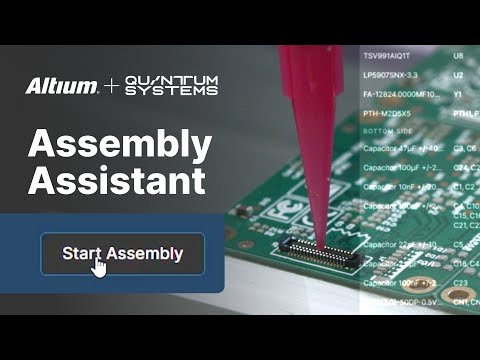
Procurement teams accessed component data directly through BOM Portal, which helped to streamline their procurement decisions and reduce risk. Their Assembly team used Assembly Assistant to get guided components placement on bare boards. Lastly, embedded engineers had access to schematics from their browser, allowing them to review design intent and pin configurations.
“When you're developing PCBs and you have this agile environment where everybody needs to work together and we have to use resources efficiently, it's important that designs are available to everybody. It’s really focused to have it inside Altium Designer and not to spread to other software like Excel or emailing.”
Component Selection and Supply Chain Risk Early in Design
In a system composed of multiple PCBs and integrated subsystems, component selection plays a critical role in determining manufacturability and long-term reliability. Choosing components without full visibility into lifecycle status, compliance requirements, or availability can introduce risks that are difficult and costly to address later.
Quantum needed a way to incorporate supply chain considerations directly into the design process, rather than treating them as a downstream validation step.
Using BOM Portal within Altium, powered by Octopart data, Quantum integrated supply chain intelligence into its design workflow. Engineers were able to evaluate component availability, lifecycle status, compliance, and pricing while making design decisions, rather than verifying these factors after the design is complete.
This approach provided real-time access to distributor and component data within the same environment used for design and collaboration. By moving component validation earlier in the process, Quantum reduced the risk of selecting unavailable or non-compliant parts and improved confidence in the design before it reached production.
“When we start to design, we can already make the decision if a part is good to use for the designs. With Octopart and the new procurement module in Altium 365, we have all the information we need—we don’t have to look it up, it’s all there.”
Enabling System-Level Scale Across Engineering Workflows
Quantum Systems is working toward a future where aerial intelligence is delivered through fully autonomous, service-based platforms, a vision that depends on both advanced system design and the ability to manage increasing engineering complexity. By adopting Altium, the company has created a connected development environment that unifies design, collaboration, procurement, and production workflows. This foundation enables teams to operate from shared data, reduces coordination overhead, and maintains alignment as system complexity grows.