
インサイト
概略
- Insightsにアクセスし、要件の状態、検証、アクティビティ、品質に関する情報を読み取る方法を学びます。
- 評価プロンプトへの指示の追加を含め、品質評価の実行方法と更新方法を理解します。
- 要件の品質評価に使用される採点基準とINCOSEルールを確認します。
要件モジュールのインサイト機能では、プロジェクト内の仕様書やセクションに含まれる要件の現状を、視覚的にまとめて確認できます。この対話型ツールでは、さまざまなフォルダー、仕様書、セクションにわたる要件の状態、検証ステータス、ディスカッションの状況などを俯瞰できます。プロジェクトの進捗をすばやく把握し、対応が必要な領域を特定するのに役立ちます。
インサイトへのアクセス
インサイト機能にアクセスするには、プロジェクトの要件モジュールに移動し、右上の  ボタンをクリックします。
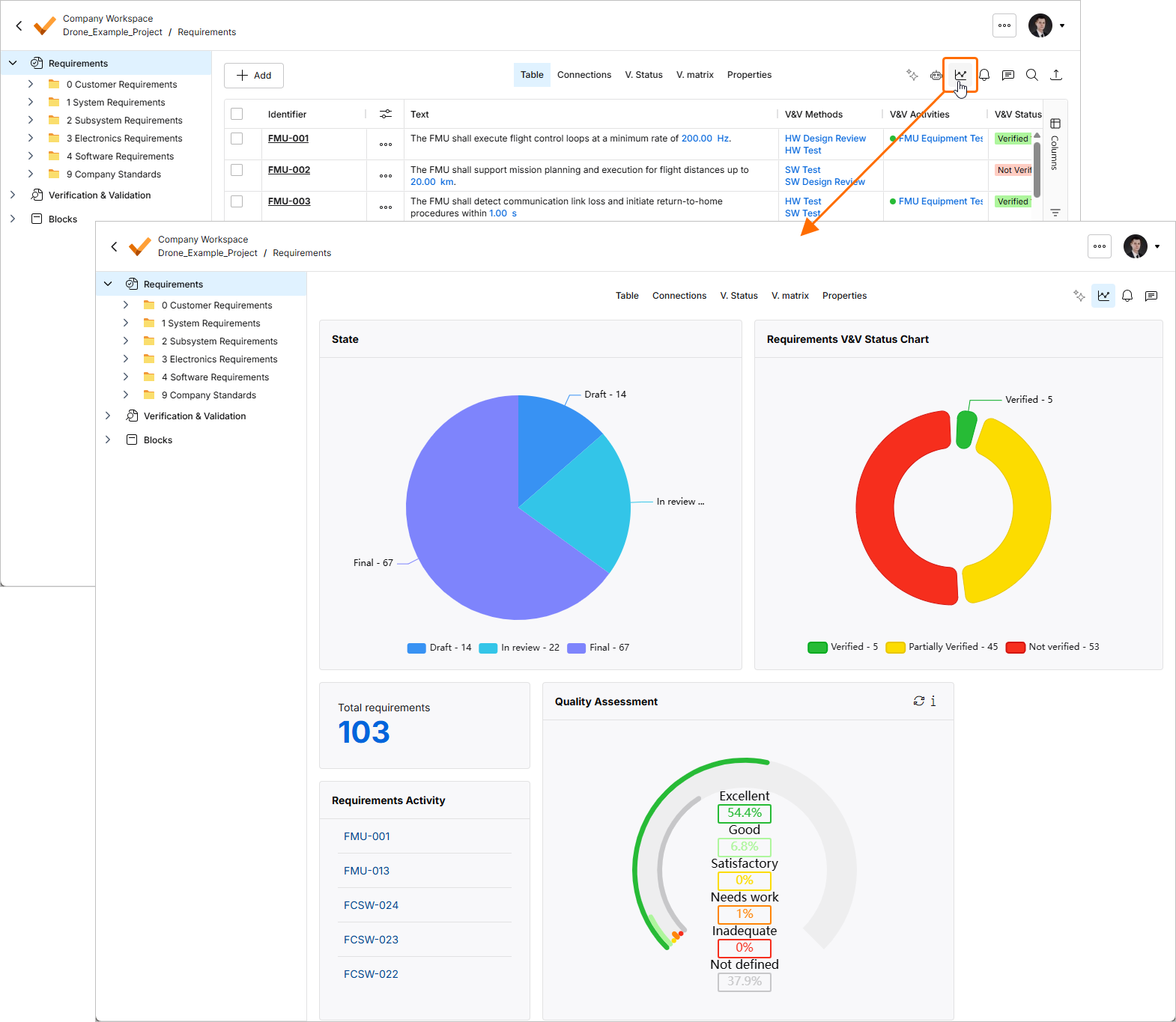
インサイトのインターフェース
インサイト機能を開くと、いくつかのグラフが表示されます。これらのグラフは、仕様書、セクション、またはフォルダー内の要件に基づいて生成されます。現在、インサイトには次の情報が表示されます。
-
状態
-
要件のV&Vステータスチャート
-
仕様書/セクション/フォルダー内の要件数
-
要件のアクティビティ(最近変更された要件を表示)
-
品質評価グラフ
状態グラフ
この円グラフには、各状態の要件の割合が表示されます。
-
Not Defined: まだ定義されていない要件。
-
Draft: 現在ドラフト段階にある要件。
-
In Review: レビュー中の要件。
-
Final: 確定済みの要件。
要件のV&Vステータスチャート
もう一つの円グラフには、仕様書内の検証済み、未検証、一部検証済みの要件数が表示されます。
-
Not Verified: 未検証の要件。
-
Partial Verified: 一部が検証済みの要件。
-
Verified: 完全に検証済みの要件。
品質評価
Quality Assessment機能は、高品質な要件の維持を支援するAI搭載ツールです。複数の品質パラメーターに照らしてテキストを評価し、各要件に対してQuality Assessment ScoreとQuality Assessment Commentを提供します。これらは、要件モジュール内の対応する列に表示されます。これにより、さらに改善が必要な要件をすばやく特定できます。
品質評価へのアクセス
品質評価機能を使用するには、要件を選択して  ボタンをクリックし、Assistant » Quality Assessmentコマンドを選択します。Quality Assessmentウィンドウが開き、分析対象の要件数が表示されます。Prompt Extension領域のテキストフィールドを使用して、追加の指示を入力できます。
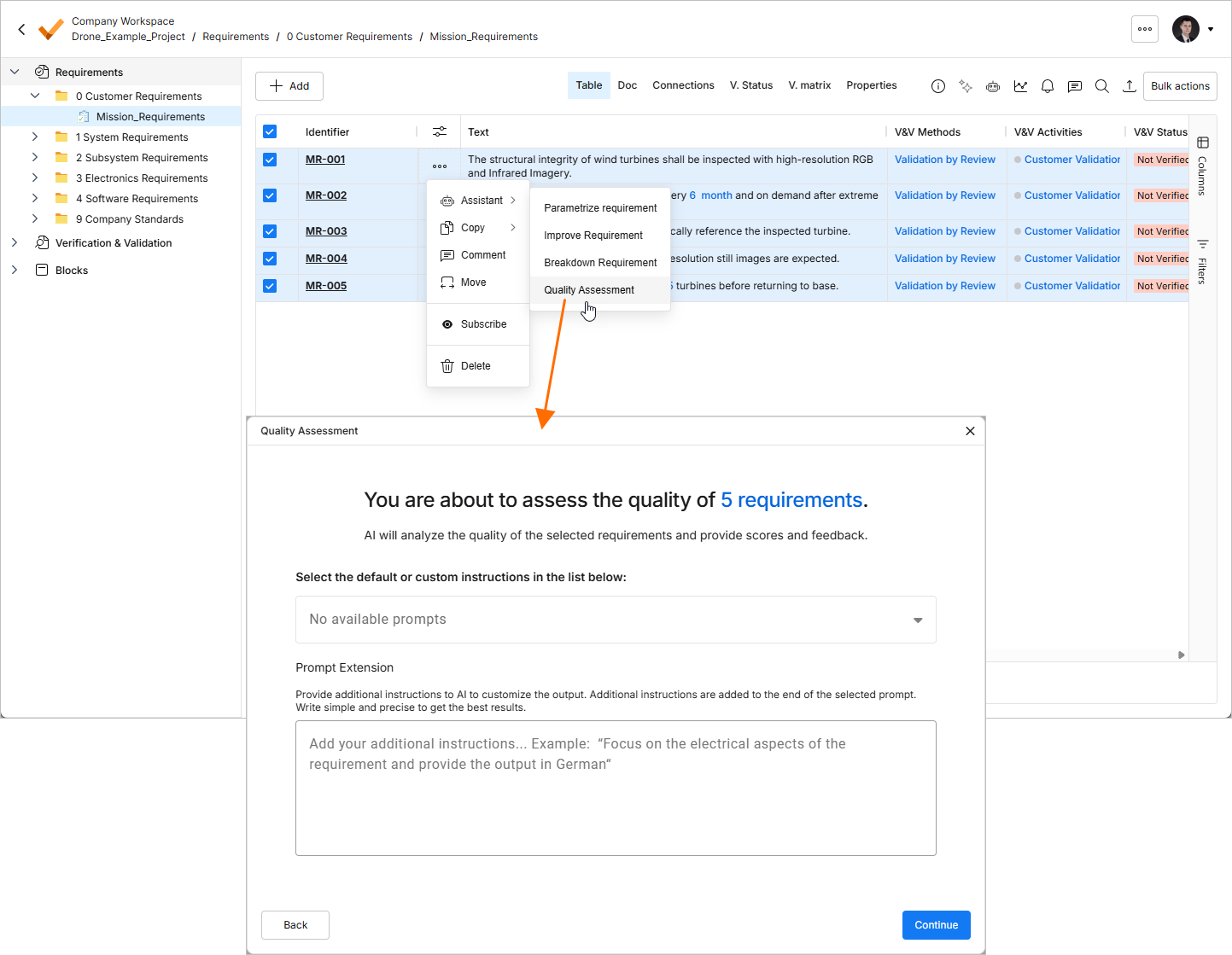
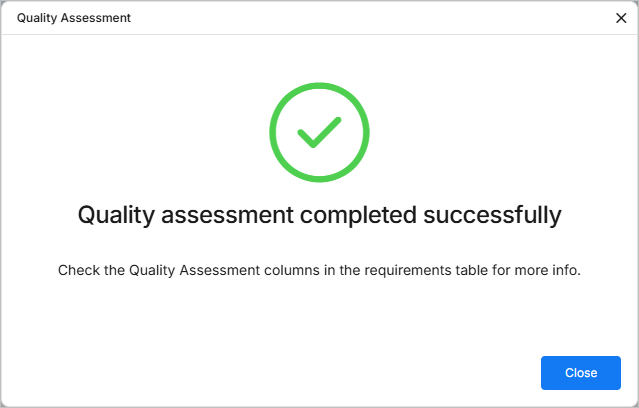
 をクリックして続行します。処理が完了すると、次のウィンドウに品質評価が正常に完了したことが表示されます。
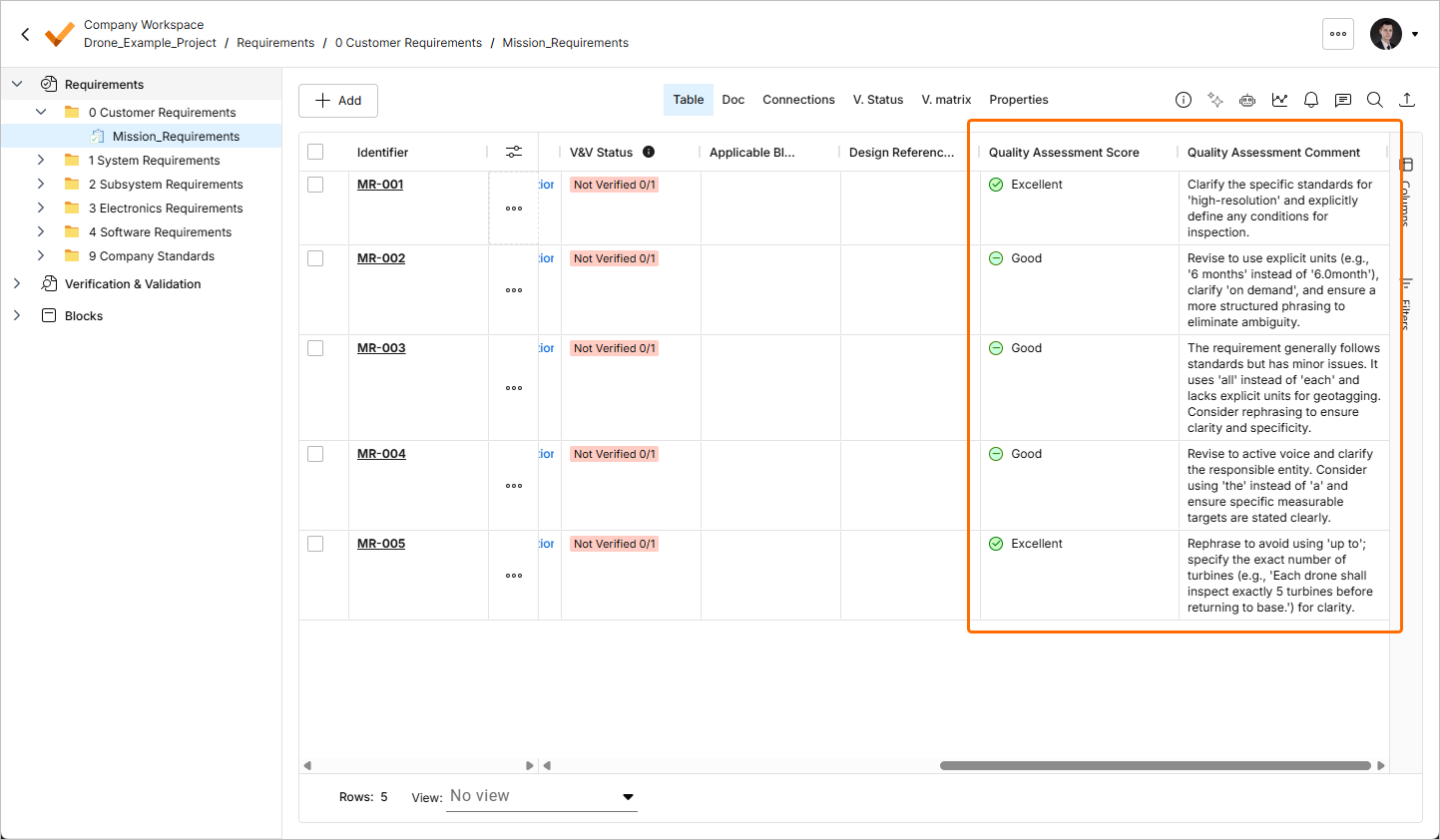
仕様書の表にあるQuality Assessment Score列とQuality Assessment Comment列には、要件テキストの品質に関する追加情報が表示されます。
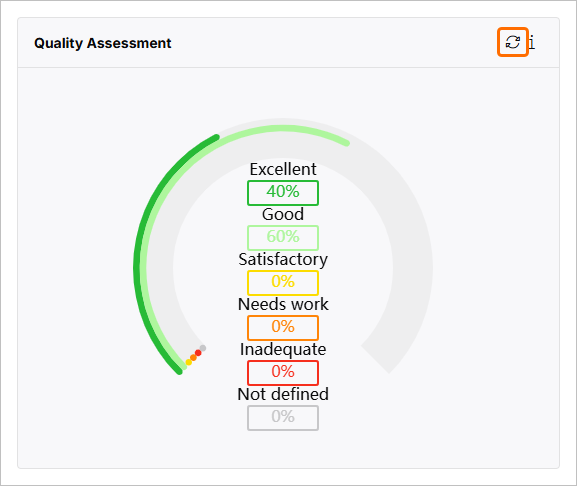
Insightsビューの Quality Assessment グラフには、更新された結果が表示されます。 再評価する場合は、グラフの右上にある  ボタンをクリックして更新することもできます。
採点基準
-
Score: 0-20 / 1(レベル1 - 不十分)
-
基準:要件テキストが複数のINCOSE基準に違反しています。構造が不明確で、受動態や曖昧な用語が使われており、文法や句読点にも問題があります。責任主体が明確でない、内容が曖昧、または実行可能でない状態です。
-
-
Score: 21-40 / 2(レベル2 - 改善が必要)
-
基準:一部の基準には従っていますが、重大な問題があります。ある程度構造化されていても、受動態や抜け道となる条項が含まれている、または具体的で測定可能な目標が欠けている場合があります。
-
-
Score: 41-60 / 3(レベル3 - 概ね良好)
-
基準:全体として基準に従っていますが、軽微な問題がいくつかあります。概ね構造化されていても、軽微な文法上の誤りがある、または具体的な測定単位が欠けている場合があります。
-
-
Score: 61-80 / 4(レベル4 - 良好)
-
基準:ほとんどの基準に従っています。適切に構造化され、能動態が使われており、具体的で測定可能な目標がありますが、軽微な問題が1つか2つ残っている場合があります。
-
-
Score: 81-100 / 5(レベル5 - 優秀)
-
基準:すべての基準に完全に従っています。構造が明確で、能動態が使われており、具体的で測定可能な目標があります。文法上の誤りがなく、曖昧さがなく、実行可能です。
-
評価で考慮されるINCOSEルール
R1 - Use a structured, complete sentence: subject, verb, object.
R2 - Use the active voice in the main sentence structure of the need or requirement statement with the responsible entity clearly identified as the subject of the sentence.
R3 - Ensure the subject and verb of the need or requirement statement are appropriate to the entity to which the need or requirement refers.
R5 - Use definite article “the” rather than the indefinite article “a”.
R6 - Use appropriate units when stating quantities. All numbers should have units of measure explicitly stated.
R7 - Avoid the use of vague terms such as “some”, “any”, “allowable”, “several”, “many”, “a lot of”, “a few”, “almost always”, “very nearly”, “nearly”, “about”, “close to”, “almost”, and “approximate”.
R8 - Avoid escape clauses such as “so far as is possible”, “as little as possible”, “where possible”, “as much as possible”, “if it should prove necessary”, “if necessary”, “to the extent necessary”, “as appropriate”, “as required”, “to the extent practical”, and “if practicable”.
R9- Avoid open-ended clauses such as “including but not limited to”, “etc.” and “and so on”.
R10 - Avoid superfluous infinitives such as “be designed to”, “be able to”, “be capable of”.
R12, 13, 14 - Use correct grammar, spelling, punctuation.
R15 - Use a defined convention to express logical expressions such as “[X AND Y]”, “[X OR Y]”, [X XOR Y]”, “NOT[X OR Y]”.
R16 - Avoid the use of “not”
R17 - Avoid the use of the oblique ("/") symbol except in units, i.e. km/hr
R18 - Write a single sentence that contains a single thought conditioned and qualified by relevant sub-clauses.
R19 - Avoid combinators that join clauses, such as “and”, “or”, ”then”, ”unless”, ”but”, ”as well as”, ”but also”, ”however”, ”whether”, ”meanwhile”, ”whereas”, ”on the other hand”, or ”otherwise”.
R20 - Avoid phrases that indicate the purpose of the need or requirement.
R21 - Avoid parentheses and brackets containing subordinate text.
R22 - Enumerate sets explicitly instead of using a group noun to name the set.
R24 - Avoid the use of pronouns and indefinite pronouns.
R26 - Avoid using unachievable absolutes such as 100'%' reliability, 100'%' availability, all, every, always, never, etc.
R28 - Express the propositional nature of a condition explicitly for a single action instead of giving lists of actions for a specific condition.
R29 - Classify the needs and requirements according to the aspects of the problem or system it addresses.
R31 - When defining design inputs avoid stating a solution unless there is rationale for constraining the design. Focus on the problem “what” rather than the solution “how”.
R32 - Use “each” instead of “all”, “any" or “both” when universal quantification is intended.
R33 - Define quantities with a range of values appropriate to the entity to which they apply and to which the entity will be verified or validated against.
R34 - Provide specific measurable performance targets appropriate to the entity to which the need or requirement is stated and against which the entity will be verified to meet.
R35 - Define temporal dependencies explicitly instead of using indefinite temporal keywords such as “eventually”, “until”, “before”, “after”, “as”, “once”, “earliest”, “latest”, “instantaneous”, “simultaneous”, “at last”.
R38 - Avoid the use of abbreviations.
品質評価グラフ
この円形グラフには、要件の品質レベルが表示されます。
-
High: 品質が非常に高い要件を示します。
-
Medium: 適切に定義されているものの、改善の余地がある要件を示します。
-
Low: 大幅な改善が必要と考えられる要件を示します。
-
Not Defined: 未評価、または十分な情報がない要件を示します。
 AI で翻訳